
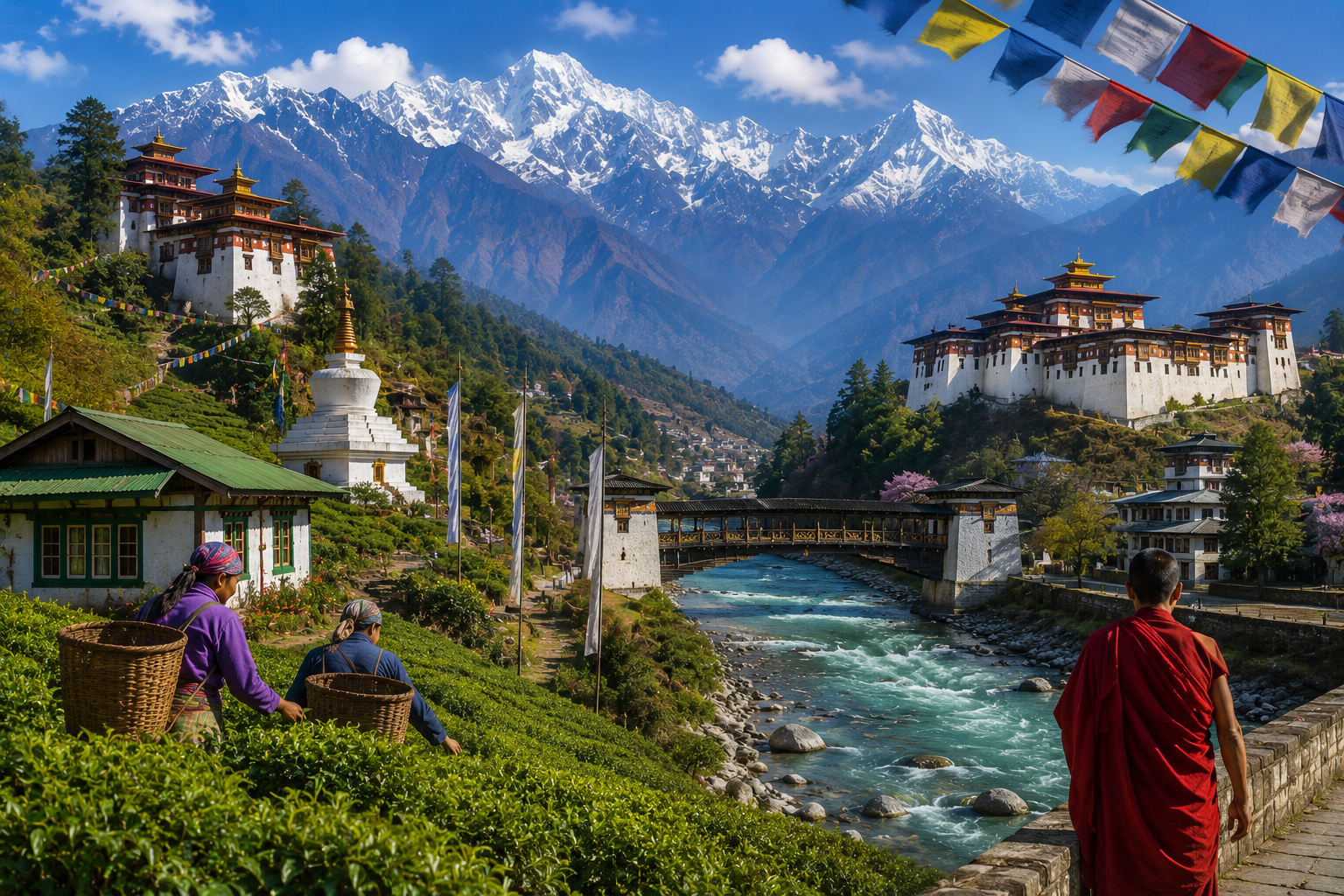
On this journey, you will experience a beautiful blend of a region in India that remains relatively unexplored, and one of Asia’s most unique destinations: Bhutan. You will begin in the Indian state of Sikkim, which remained an independent Himalayan kingdom until 1975. Here, you will visit various monasteries and delight in landscapes filled with rugged hills and numerous lakes. A particular highlight is spending nights in homestays and pausing amidst lush tea gardens. At Phuentsholing, you will cross the border into Bhutan—a land whose culture is rendered even more distinct and mystical by its location along the fringes of the Himalayas. Here, you will explore various fortress-monasteries and interact with the region’s welcoming people. Throughout this trip, you will witness a truly unique facet of Asia.
Why This Trip?
- Private car transport with a dedicated driver
- Accompanied by English-speaking local guides in Sikkim and Bhutan
- Most meals included; some additional expenses apply
- Special Feature: Homestay accommodation in Sikkim
- Bhutan visa included
- More luxurious hotel options are also available at an additional cost
- Flexible Itinerary: If you prefer a more active program, we can incorporate various hikes to monasteries, mountain passes, and lakes.
Your trip begins today with Best Travel Agents in India. Upon your arrival at Delhi Airport, our representatives will welcome you and escort you to your hotel.
In the morning, you will be escorted back to Delhi Airport to catch a domestic flight to Bagdogra. Upon reaching Bagdogra, you will be welcomed by your driver and guide, who will accompany you throughout your stay in Sikkim. Together, you will embark on a journey of approximately 3 hours to reach Turuk—a small village nestled on a mountain ridge near Melli. Along the way, you will pass through the city of Siliguri and traverse the route alongside the Teesta River, passing through several villages. From Melli, the road winds uphill until you finally arrive at Turuk village. You will spend the night here in a heritage bungalow. The remainder of the evening is yours to spend at leisure.
After an early breakfast, you will be taken to the Tare Bhir Viewpoint; from here, you can enjoy a magnificent panoramic view of the Kalimpong hills and the distant Teesta River flowing below. You will then continue your drive towards the town of Pelling, passing through pine forests and small settlements along the way. Upon arrival, you will check in to your hotel. In the afternoon, you may choose to take a walk to the Pemayangtse Monastery, which is perched atop a hilltop. The walls of the monastery are adorned with paintings depicting scenes from Tibetan mythology. While the frescoes here have deteriorated somewhat over time, this does not diminish their charm—in fact, one might argue quite the opposite. This walk takes approximately 45 minutes. If you wish, you may also visit the ruins of Rabdentse, the former capital of the Kingdom of Sikkim.
Note: If you prefer not to walk to Pemayangtse, the visit can also be undertaken by car.
Today, you will begin your day with a trek of approximately one and a half hours to the Sanga Choeling Monastery—a magnificent structure perched atop the forested hills opposite the Pemayangtse Monastery. Originally built to serve as a meditation hall, the building now functions as a full-fledged monastery. Sanga Choeling is, in fact, one of the oldest monasteries in Sikkim. Afterward, your driver will take you to your next destination: Temi. This region is renowned for its tea production, and you will be greeted by hillsides blanketed in tea bushes. High-quality organic tea is cultivated here. Before reaching your final destination, you will visit the 'Buddha Park'—also known as Tathagata Tsal—which houses a colossal statue of the Buddha. This statue is visible from a vast expanse of West Sikkim. You can venture inside the statue itself; along the interior walls, you will discover paintings depicting the fascinating life story of the historical Buddha, Siddhartha Gautama. It is also an excellent spot to take a break and enjoy a cup of Temi tea. Today, you will check into a local homestay—a community-based initiative designed to promote rural tourism. While the rooms feature private bathrooms, the amenities are basic. Experiencing village life up close in this manner is a truly unique and special experience .
Note: Should you prefer to stay in a hotel, we would be happy to provide recommendations
In the morning, you will visit one of the many local tea gardens. You will observe the workers busily plucking fresh leaves, preparing them for processing into tea. They are always happy to engage in conversation. At a small tea factory, you can witness the entire process of transforming fresh leaves into finished tea. Here, too, the workers will be delighted to chat with you. You can gain further insight into their way of life by observing their homes and even stepping inside to look around. You will spend the night at the homestay once again. If you wish, you are welcome to lend a hand in the kitchen; however, nothing is mandatory—you are free to do as you please.
Note: Are you looking for a bit more of an adrenaline rush? Paragliding is also available in this area. Ask about the possibilities.
After breakfast, you drive down through the tea gardens, cross the Sarwani Bridge, and follow the course of the Teesta River to reach Martam village. After checking in and enjoying a leisurely lunch, you set out with your guide for a stroll through a nearby village. Along the way, it is a delight to visit a small local school and chat with the students, who are eager to practice their English. Visitors rarely come here, so the locals are incredibly enthusiastic. This walk takes approximately 2 hours, with another 2 hours required for the return journey. En route, you will pass through forests as well as terraced fields.
Today, after a short drive, you arrive at Rumtek. The magnificent Rumtek Monastery is perched atop a hill here. It serves as the seat of the 16th Gyalwa Karmapa, the head of the Karma Kagyu school of Tibetan Buddhism. The monastery is adorned in a distinctively colorful style.Day 6: Martam
After breakfast, you drive down through the tea gardens, cross the Sarwani Bridge, and follow the course of the Teesta River to reach Martam village. After checking in and enjoying a leisurely lunch, you set out with your guide for a stroll through a nearby village. Along the way, it is a delight to visit a small local school and chat with the students, who are eager to practice their English. Visitors rarely come here, so the locals are incredibly enthusiastic. This walk takes approximately 2 hours, with another 2 hours required for the return journey. En route, you will pass through forests as well as terraced fields.
A full day dedicated to exploring the surroundings of Gangtok with your guide. Enchey Monastery is the first stop, where cheerful novices can be seen playing amidst their very serious lessons. To catch glimpses of Hinduism in between, you will visit Hanuman Tok—a temple dedicated to the Monkey God, Hanuman—and Ganesh Tok, which, you guessed it, is dedicated to Lord Ganesha. The temples are lovely, but the views are perhaps even more spectacular. You will likely find the very best view at Tashi View Point, your next stop. From the railings of the observation tower, you can gaze out at mountain peaks stretching for miles and catch a magnificent distant view of Kanchenjunga—the world's third-highest mountain at 8,586 meters, and the pride of Sikkim. Later, you will visit the Do-Drul Chorten, a massive stupa featuring at least 108 prayer wheels. You will frequently encounter the number 108 throughout your journey; it is considered a sacred number in both Hinduism and Buddhism. For instance, a *mala* (prayer garland) consists of 108 beads, and monasteries often house 108 chortens or prayer wheels. The Do-Drul Chorten is highly popular among pilgrims; consequently, you will find devotees here from other parts of India and, quite often, from Bhutan as well. Nearby lies the Namgyal Institute of Tibetology, which houses an extensive collection of Tibetan artifacts and scriptures. Finally, you may visit the Directorate of Handicrafts and Handlooms. A detailed description of an excellent spot for purchasing souvenirs.
Note: If you have no trouble waking up early in the morning, you can also start your day by visiting Tashi View Point; there is something truly magical about witnessing the first rays of the sun striking the snow-capped peaks.
A special drive leading to a special destination: Today, you will travel by car through the Kyongnosla Alpine Sanctuary—home to a variety of rhododendrons and alpine trees—before reaching Tsomgo Lake. This lake is situated at an altitude of 3,735 meters. The waters of this mountain lake change color with the changing seasons, presenting a picture-perfect spectacle at any time of the year. For most of the year, the lake remains frozen and blanketed in snow. The Red Panda is native to this region, though you would need to be extremely lucky to spot one. Many migratory birds find this place to be an ideal stopover, and it is easy to see why. Due to its proximity to the Chinese border, hiking is generally not permitted in this area, with the exception of a designated trail located near the lake. Colorful, horned yaks are also available for tourists to ride. After visiting the lake, you will return to Gangtok. Along the way, you will make several stops to enjoy magnificent panoramic views of the surrounding mountains. You will spend the night in Gangtok once again.
Kalimpong is your next destination. Situated at an altitude of 1,250 meters, the climate here is pleasant, making it a popular choice for weekend getaways and retirement destinations. However, it is not just Indian vacationers and retirees who thrive here; orchids and gladioli also flourish in abundance. Until approximately 1700, Kalimpong was under the dominion of the King of Sikkim. However, in the early 18th century, the King of Bhutan assumed control—a rule that lasted until 1865, when the region was annexed by Darjeeling. This small town possesses a turbulent history—a stark contrast to the serene atmosphere it enjoys today. In the afternoon, you will explore this hill resort in the company of your guide. You will visit the Zang Dhok Palri Phodang Monastery, Mangal Dham, and the local flower nurseries.
Today, the journey takes a downhill course, winding through various villages and settlements, past forests and tea gardens, all the way to the Bhutanese border. Your Indian guide and driver will assist you in crossing the border and checking into your hotel on the Bhutanese side. You will meet your Bhutanese guide and driver either today or tomorrow morning. Once your route permits have been secured and border formalities completed, you may spend the remainder of the day at your leisure. Naturally, the border area is a hub of bustling trade; strolling through the local market is an excellent way to spend the afternoon.
You will be transported to the capital city, Thimphu (please anticipate a drive of approximately 5 to 6 hours). In good weather, you will be treated to beautiful panoramic views. The Himalayas rise from the plains like a natural barrier. On the way to Thimphu, you will pass through forests of coniferous trees, rhododendrons, and wild cherry trees. You will make stops at Rinchenling Monastery, various villages, or scenic viewpoints. Upon reaching Thimphu, you will be escorted to your hotel for the night. With a population of just 100,000, Thimphu is one of the smallest capital cities in the world. The city center features three main streets where you can find numerous restaurants and shops. In the afternoon, you can visit the colossal Golden Buddha statue situated on the hills overlooking Thimphu. Inside the statue, there is a temple that you are welcome to visit. En route, you will pass the Memorial Chorten, which was built in memory of the country's third king, Jigme Dorji Wangchuck. It is a place where many Bhutanese people come daily to offer prayers, circumambulate the structure, and spin the large prayer wheels. If you simply prefer to take a stroll around the city, that is certainly an option as well. In any case, your guide and driver will be at your disposal to assist you.
There are many places to visit within Thimphu and its surrounding areas. Depending on your preferences, you can consult with your guide to select a few of these sites to visit. For instance, you might visit Changangkha Monastery, the National Institute of Traditional Medicine (which houses a museum), the School of Arts and Crafts, the Textile Museum, the Folk Heritage Museum, a nunnery, or a local market where various handicrafts are available for sale. It is also possible to visit a small wildlife park where Bhutan's national animal, the Takin, can be observed. Simtokha Dzong is another site worth visiting; this small monastery is located just outside Thimphu. At the end of the day, it is a delightful experience to visit Tashichho Dzong, a magnificent monastery-fortress. These *dzongs* (monastery-fortresses) served as centers of both political and religious power. Even today, the complex houses both government offices and temples. In the late afternoon, you will observe government employees leaving the Dzong after their workday, at which point the building is opened to visitors. As you exit the Dzong, look to your left; there stands the (unassuming) Royal Palace—the residence of the current and fifth King, HM Jigme Khesar Namgyel Wangchuck. With guidance from your guide, you are free to decide for yourself how much time you wish to spend at each specific location.
Tip: The daily flag-lowering ceremony is accompanied by a fascinating array of rituals. It is truly a sight worth witnessing!
The journey to Punakha takes approximately 3 hours. This route leads you over the Dochula Pass (3050m), where—on clear days—you can behold a vast panorama of the Himalayas and admire the 108 stupas perched upon the hillside. In consultation with your guide and driver, you may make several stops along the way to savor the magnificent scenery. Do not forget to make a brief stop at the Lamperi Botanical Park; it offers an immediate introduction to the country's spectacular flora and fauna. The next highlight on the itinerary is Punakha’s main attraction: the Punakha Dzong. This colossal Dzong is situated at the confluence of two rivers, creating a truly breathtaking spectacle. The massive white walls of the fortress were clearly designed to impress both friend and foe—and they have certainly succeeded. Inside, numerous sacred relics are enshrined, and the vibrant, colorful murals are enough to leave you spellbound.
If you enjoy hiking, we can also include a trek today to either the Khamsum Yulley Temple or Chorten Ningpo; both are perched atop hills, offering stunning vistas of the valley, terraced rice fields, and the winding river below.
This morning, your first destination will be Chimi Lhakhang, the Temple of Fertility. There, you may be amused and intrigued by the biography of the beloved saint Drukpa Kunley (also known as the 'Divine Madman'), whose colorful life story is vividly depicted on the temple walls. We won't give away too many details, but it is certainly an experience not to be missed! Afterward, the drive takes you back over the Dochula Pass (3050m), where the 108 stupas stand sentinel on the hillside. In consultation with your guide and driver, you can make frequent stops to enjoy the magnificent scenery.Upon reaching Paro, you can visit various sites within the city, depending on the time you have remaining: Rinpung Dzong, the National Museum, and the Kyichu and Dungtse temples. If you are already "tired of temples and monasteries," you can instead visit local homes or simply stroll through the town in search of souvenirs.
Tip for Hikers: From Dochula Pass, you can embark on a beautiful hike to Lungchutse Monastery. This trek takes approximately 3.5 hours, and along the way, you will encounter a diverse array of wildflowers and birds. If you wish to extend your walk by another hour, instead of returning to Dochula Pass via the same route, you can descend via the path leading to Tashigang Gompa.
Today, you will visit one of Bhutan's most iconic landmarks. You will drive to the base of Taktsang, from where you will begin your hike up to the Tiger's Nest. Perched precariously on a cliff face at an elevation of 800 meters, this sanctuary is not only the most famous site in the country but also one of its most spectacular. It was built on the very spot where Guru Rinpoche is said to have landed in the 8th century after flying in on the back of a pregnant tigress. Guru Rinpoche—also known as Padmasambhava—is revered as an incarnation of the Buddha and the figure who introduced Buddhism to Bhutan. He is credited with subduing numerous demons at this site and meditating in a cave here for three months. The current temple complex is built around this very cave. You can visit the various shrines within the complex before descending to the cafeteria, where you will have lunch. Afterward, the descent back to the pickup point—where your driver will be waiting for you—takes approximately one hour. This afternoon, you can visit Kyichu Lhakhang—one of Bhutan's oldest temples—or explore other sites that you did not get a chance to see yesterday.
You will be transferred to Paro Airport for your flight to Delhi (included). Upon arrival, you will be taken to a hotel near the airport for your final (often short) overnight stay.
After breakfast explore New & Old Delhi. Your hotel till 12h00, later one of our representatives will lead you till New Delhi International airport, take onward flight. End our services.
- Traditional welcome on arrival at Delhi, Bagdogra & Paro (Bhutan)
- Assistance during your trip (available 24 hours)
- Regional flights: Delhi–Bagdogra and Paro–Delhi
- Private transfers and transportation by car with a dedicated driver throughout your trip
- Expert, English-speaking local guides for destinations within India
- An expert accompanies tour guide, English-speaking entire part of Bhutan
- All overnight stays as per the itinerary
- Meals as per the itinerary (Bhutan part on full board)
- All services mentioned in the itinerary above
- Special attractions and associated entry fees
- Bhutan Visa (Cost: USD 50 per person)
- Bhutan Tourism Development Fee (Cost: USD 10 per person)
- A comprehensive information package accompanying your travel documents, including country information, vouchers, e-tickets, and a hotel list
- Any International flights (to / from Delhi)
- India Visa costs: E-Visa at USD 25 per person (must be applied for prior to departure)
- Personal expenses, including beverages
- Optional excursions and associated entry fees
- Tips and camera usage fees
- Travel and cancellation insurance
- Anything else that is not mentioned in the "price includes" section.