
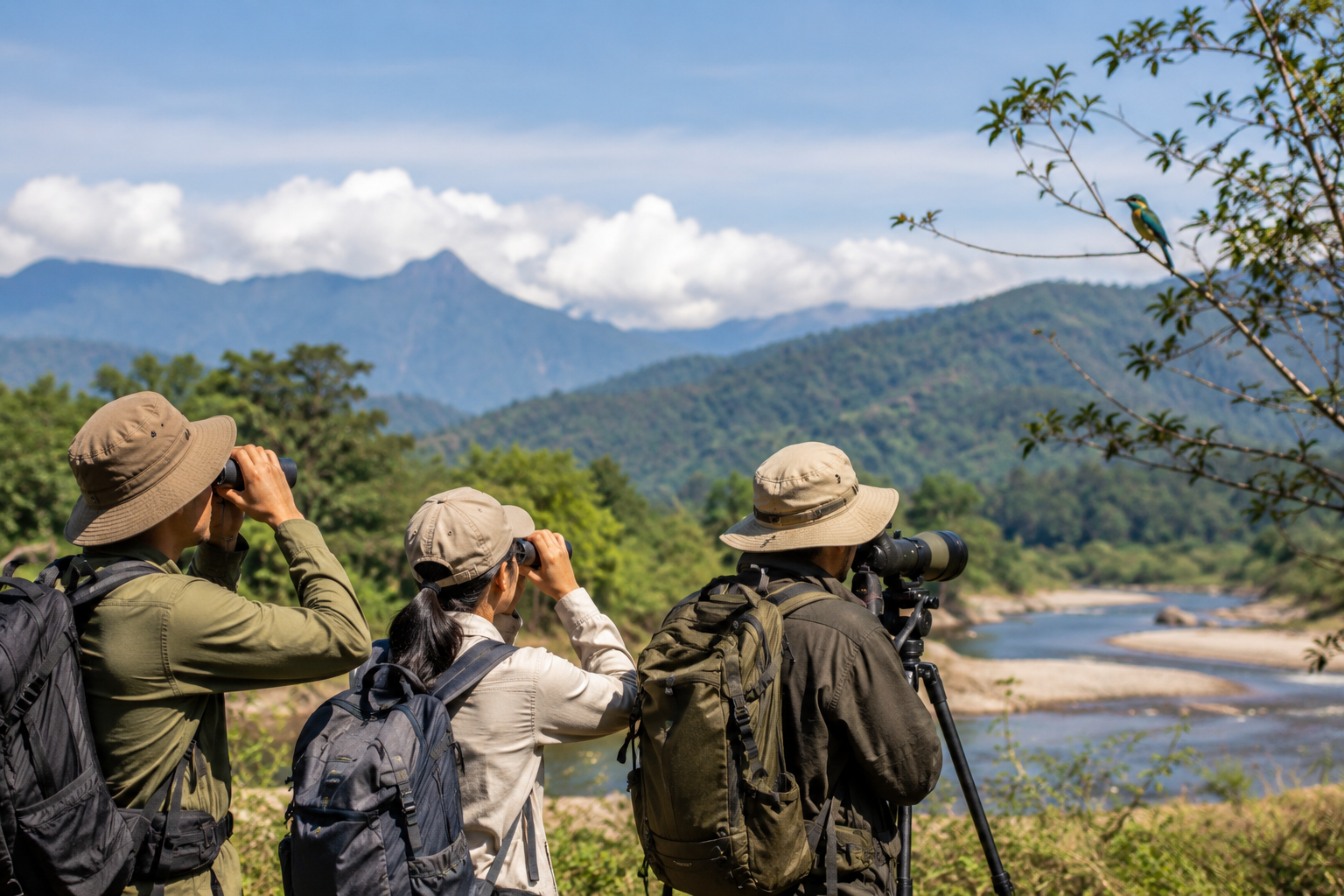
This birdwatching trip is just one example of the many excursions we organize within this magnificent birding destination. Encompassing an area roughly the size of Switzerland, the region features a diverse array of climatic zones—and, consequently, a wide variety of avian species. Ranging in elevation from 97 meters to 7,570 meters, the landscape offers opportunities to observe a multitude of species. Currently, 673 species have been recorded; however, new species are discovered regularly, as much of Bhutan’s natural beauty remains yet to be explored.
While many birds can be easily spotted from the roadside, you will also encounter several rare species that are more elusive—requiring a bit of extra effort to locate—such as the “Holy Grail” of Bhutanese birding: the extremely rare White-bellied Heron. On all our birdwatching trips, you will be accompanied by our certified and experienced birdwatching guides as you explore these diverse climatic zones. Every trip is private, ensuring you have ample time to observe the specific species that interest you most. Accommodation will be provided in mid-range hotels, subject to availability. Should a hotel not be available, you will camp at fully equipped campsites.
Birdwatching: Preferences
In this sample itinerary, we visit the Yongkola birdwatching site; however, an excursion to the Royal Manas National Park is also a viable option. If you have specific species you wish to observe, we will customize the itinerary to maximize your chances of spotting them. Please also consult with our guides to determine the optimal time of year for undertaking this birdwatching trip.
Why This Trip?
- Birding across diverse climatic zones: along riverbanks, in deciduous forests, coniferous forests, and subtropical and tropical woodlands.
- An exceptional variety of bird species concentrated within a relatively small geographical area.
- All transportation throughout the trip is provided via private car with a dedicated driver.
- Includes the services of an expert, certified bird guide in Bhutan (English-speaking).
- The sample itinerary can be flexibly customized if you wish to target specific bird species; please inquire about the possibilities.
- The trip itinerary can also be flexibly adjusted if you wish to incorporate additional cultural sites into your route.
- A truly comprehensive trip: all meals during your stay in Bhutan are included.
Today, your journey with Best Travel Agents in India begins. Upon your arrival at Kathmandu Airport, our local representative will welcome you and escort you to a centrally located hotel. Here, you can check in and freshen up.
In the afternoon, accompanied by your private guide, you will visit Durbar Square (meaning: 'Palace Square'). Durbar Square is the beating heart of Kathmandu and its most iconic attraction. The square is home to numerous religious monuments, all constructed between the 12th and 18th centuries. The most famous among them is the Kumari Bahal, the residence of the living child goddess, Kumari.
Beyond the structures of Durbar Square, Kathmandu boasts many other magnificent buildings, several of which are inscribed on UNESCO's World Heritage List. If you have additional time, we recommend staying an extra night in Kathmandu to visit the grand Buddhist stupa of Boudhanath, the Hindu pilgrimage site of Pashupatinath, and the Buddhist 'Monkey Temple' of Swayambhunath. These are all destinations well worth exploring!
After breakfast, you will be transferred to Kathmandu Airport for a regional flight to Paro. The views of the mountains are spectacular, and the experience of landing on the airstrip at Paro Airport is truly exhilarating.
Your birding adventure begins right here. You will often hear birdwatchers remark that it is possible to spot the rare Black-necked Ibis just minutes after landing at Paro Airport—and this is no exaggeration!
You drive approximately 4 kilometers north, and here, along the banks of the Paro Chhu (Chhu = river or water), you have an excellent opportunity to spot them. The journey continues by car along the Paro Chhu towards Drukgyel Dzong, where you have the chance to observe the Black-masked Laughingthrush, as well as the Brown Dipper, Spotted Laughingthrush, and Fire-capped Tit.
At the end of the day, you arrive in Thimphu, the capital of Bhutan. In reality, it is just a one-hour drive from Paro Airport, but you can take as much time as you wish to look for birds along the way. With a population of just 100,000, Thimphu is one of the smallest capital cities in the world. The city center features three main streets where you can find numerous restaurants and shops.
If time permits, you can visit the National Memorial Chorten in Thimphu. It is a place where many Bhutanese come daily to offer prayers, circumambulate the structure, and spin the large prayer wheels. Tashichho Dzong—a magnificent monastery-fortress—is also a must-see attraction. These Dzongs, or monastery-fortresses, served as centers of both political and religious power. Even today, the government offices and the temple are housed within the same complex. In the late afternoon, you will observe government employees leaving the Dzong after their workday, at which point the building is opened to visitors.
Today, you will travel to Punakha, situated at a lower elevation (and therefore warmer). The route traverses the Dochula Pass, at an altitude of 3,050 meters, from where—on a clear day—you can admire a vast expanse of the Himalayas, and where 108 stupas stand built into the hillside. In consultation with your guide and driver, you may stop at several points along the way to soak up these spectacular views. You will go birdwatching within the cool deciduous forests and mixed coniferous woodlands. You will also take a short walk along the trail leading to the Trashigang Monastery. In this area, you may be lucky enough to spot the Satyr Tragopan, Spotted Nutcracker, Large Hawk-cuckoo, Darjeeling Woodpecker, Eurasian Magpie, Rufous-vented Yuhina, Collared Grosbeak, Ultramarine Flycatcher, and Brown Bullfinch. In the afternoon, you will continue your journey toward Punakha, making stops at excellent birdwatching sites along the way.
The Lampari Botanical Park is also well worth a brief stop, offering an immediate introduction to Bhutanese flora. As you traverse the magnificent Wangdue Valley, you will visit Chimi Lhakhang—the Temple of Fertility. Here, you can admire the life story of the beloved saint Drukpa Kunley (also known as the "Divine Madman"), whose illustrious life is depicted on the temple walls. We won't reveal any more details, but it is undoubtedly an unforgettable experience! Afterward, you will be driven to Punakha, which served as the capital of Bhutan for over 300 years. The main attraction here is the Punakha Dzong, which you will visit today. This imposing dzong stands at the confluence of two rivers, offering a spectacular panorama. The fortress’s high white walls were evidently built to impress both friends and foes—and they certainly succeeded. Inside, numerous sacred objects are preserved, and the profusion of colorful paintings might well make your head spin.
The next drive will take you into the warm deciduous forests of Tashithang. Here, you may spot the Great Barbet, Barred Cuckoo-Dove, Oriental Magpie-Robin, Green Magpie, Pallas's Fish-Eagle, Osprey, River Lapwing, Ruddy Shelduck, Eurasian Wigeon, Common Merganser, Pied Kingfisher, Red-vented Bulbul, and many other birds. Since no mid-range hotels or guesthouses are available in this area, we will set up camp for the first time on this trip. Sturdy sleeping tents equipped with stretcher beds and mattresses, a cooking/dining tent, and a toilet tent will be provided. In the evening, you will enjoy a meal prepared by the cook and can sit late into the night around a campfire beneath the starry sky.
You will be provided with a bowl of warm water along with your 'morning tea' to freshen up. After breakfast, you will proceed towards Gangtey, traveling through both warm and cold deciduous forests. Here, you will have the opportunity to spot the Scarlet Finch, Black Drongo, Chestnut-bellied Nuthatch, Slaty-backed Forktail, Gorged Flycatcher, White-throated Laughingthrush, Eurasian Jay, Wedge-tailed Green Pigeon, Mountain Imperial Pigeon, and Verditer Flycatcher. You will camp once again in Tashithang. Despite being a small country, Bhutan boasts a wide variety of species due to the presence of numerous distinct biotopes within its borders. Furthermore, thanks to its central location situated between two biogeographical zones, it is a highly popular destination for migratory birds—such as the Black-necked Crane—that arrive here to spend the winter. Furthermore, the fact that the country possesses a centuries-old tradition of protecting nature certainly helps. The country has a sparse population, industrial development has been minimal, and—in accordance with Buddhist values—people are expected to care for all living beings. Monarchs have historically prevented forests from being felled for new development projects, and numerous regulations remain in place today to safeguard the natural environment. Environmental conservation is considered one of the key pillars of Gross National Happiness. From the Bhutanese perspective, nature itself is the ultimate source of all happiness. As a result of all these factors, a wide variety of bird species thrive here. It is even said that the birds here are less skittish and approach humans more readily because they are not hunted. Consequently, one can easily spot a long list of rare and elusive bird species.
En route to Trongsa, you will make several stops once again to observe the local birdlife. Within the bamboo forests of this region, one can encounter the Himalayan Monal, Satyr Tragopan, Blood Pheasant, and Parrotbill. Additionally, you may spot the Mountain Bulbul, Striated Bulbul, Common Kestrel, Spot-winged Grosbeak, Mountain Hawk-Eagle, Whiskered Yuhina, Wallcreeper, and Himalayan Swiftlet. Today's journey takes you across the Pele La Pass (3,400m). On clear days, the majestic peak of Jomolhari (7,326m) comes into view. In Bhutan, the tree line extends to a remarkably high altitude—approximately 4,000 meters. Consequently, a diverse array of wildlife can be observed even at such high elevations.
In the morning, you will visit the Dzong and the Watchtower. The Watchtower currently houses a museum. If you feel a bit overwhelmed by the sheer number of saints, kings, and historical figures associated with Bhutanese cultural history, be sure to watch the short introductory film shown in the watchtower; it will provide you with an immediate overview of Bhutanese history and legends. Additionally, the authentic Raven Crown—worn by the King on special occasions—can be viewed here. The raven is a powerful symbol in Bhutan. Naturally, Buddhist tenets forbid causing harm to any living creature; however, anyone who harms a raven truly invites the wrath of the deities upon themselves, unleashing a flood of misfortune.After exploring the magnificent structures of Trongsa, you will be taken to the Bumthang Valley, a journey of approximately three hours by road. Bumthang is, in fact, a collective name for four distinct valleys located in central Bhutan: Jakar, Tang, Chhume, and Ura. With its abundance of Buddhist monasteries, distinct dialects, and unique local cuisine, this region serves as the cultural heart of the country. You will be camping in the Ura Valley for the next few days. En route, you will make stops amidst bamboo groves and coniferous forests to observe the local birdlife. The species commonly found in this area include the Great Parrotbill, Fulvous Parrotbill, Black-billed Magpie, Red-billed Chough, Eurasian Hobby, and White-winged Grosbeak.
You will begin the day with a visit to the temple in Ura Village. Afterward, you will head out from the road into the coniferous forest for a birdwatching excursion. Here, you may spot the Himalayan Monal, Blood Pheasant, Snow Pigeon, Crossbill, Fire-tailed Sunbird, and Plain Mountain Finch. You will spend the night once again at the campsite.
Note: For larger travel groups (exceeding 6 people), the designated campsite is too small to accommodate large luxury tents; therefore, we provide lighter, more compact tents.
You will travel to Yongkola, your next prime birdwatching destination. Along the way, you will observe birds within the bamboo groves that line your route. The magnificent Himalayan Robin, Zebra Finch, Little Forktail, White-capped Redstart, Rufous-bellied Rock Thrush, Great Tit, Green-tailed Sunbird, and Long-tailed Minivet are regularly sighted here. Furthermore, this forest is home to another unique animal: the Red Panda! With a little luck, you might even catch a glimpse of one.
Your guide will take you birdwatching in the cool deciduous forests near Namling. This is one of Bhutan’s best-preserved—and still relatively undiscovered—forests. Here, you may spot Ward's Trogon, the Satyr Tragopan, the Grey-chinned Minivet, the Chestnut-breasted Partridge, the Striated Laughingthrush, and the Rufous-necked Hornbill. Incidentally, if you spot a crane, swan, duck, or pheasant flying overhead—or if you hear their calls—it is considered a good omen, a blessing from the Buddha. By the end of this journey, you are sure to feel truly fulfilled!
Today, we turn our attention to the subtropical rainforest and its avian inhabitants: the Blue-throated Bee-eater, Maroon Oriole, Greater Racket-tailed Drongo, Red-headed Trogon, Grey Jay, Grey Nightjar, Hill Prinia, and Asian Emerald Cuckoo. This evening, you will savor a delicious meal prepared by your cook using fresh, organic ingredients. Traditionally, the changing of the seasons is interpreted based on the arrival and departure of specific birds. For instance, the sighting of a particular bird signals the time for rice sowing. Birds also foretell changes in the weather, and often, it is a bird that determines the chosen site for a *dzong*. In addition to providing precise details about Bhutan’s bird species, your guide will also regale you with the many myths and legends in which birds play a pivotal role—stories perfect for sharing around a campfire...
You descend to an altitude of 650 meters, where you reach the banks of the Kuru Chhu River and the bridge that spans it. Here, you can observe the birds that frequent the riverbanks in this tropical region of the country. You will also spot birds in the vicinity of the ruins of Shonggar Dzong. This “dzong” was eventually abandoned and replaced by the Mongar Dzong. Enjoy one final night of camping beneath the star-studded Himalayan sky.
Today, you return to the Bumthang Valley. If driving directly, the journey takes approximately four hours; however, due to numerous stops for birdwatching along the way, the trip will likely take between seven and eight hours. You will spend the night at a charming lodge in Jakar, hosted by a welcoming local family.
Today’s itinerary involves a long day of travel as you make your way back to Punakha. En route, you may choose to stop at the same locations visited on your outward journey, or explore different spots. You can discuss your preferences with your guide on site. You will once again spend the night at a hotel you are already familiar with—perched high above Punakha—offering panoramic views of the valley and the river below.Note: If the long return journey is a concern for you, we can also arrange a domestic flight from Bumthang to Paro at an additional cost. Druk Air operates these flights daily, allowing you to cover a considerable distance. However, it is advisable not to schedule this flight for your final day, but rather to allow for a few extra days.
On the return journey from Punakha to Paro, you will have the opportunity to spot birds you may have missed along the way. Feel free to discuss with your guide any specific species you are still hoping to see, so that he can point out the best locations. It is also possible to travel to Paro by car with minimal stops, allowing you to dedicate the afternoon to visiting the fortress-monastery of Rinpung Dzong. The museum housed within the watchtower is also well worth a visit.
Note: If you wish to visit Bhutan’s famous landmark—the Tiger’s Nest (a nature reserve perched on a hillside overlooking the Paro Valley)—we can add an extra day to your itinerary.
After an early breakfast, you will be transferred to Paro Airport. There, you will check in your luggage for your flight to Kathmandu. To facilitate a smooth connection, an overnight stay in Paro has been planned. Upon arrival at the airport, you will be met and transferred to your designated hotel in the city. The remainder of the afternoon is free for you to spend at leisure. Should you wish to explore the city and its surroundings with a guide, we would be happy to arrange such an excursion.
Depending on the departure time of your return flight, you may have some free time in Kathmandu. As an optional extra, we can arrange a scenic flight over the Himalayas in a small aircraft (approximately 1 hour; price available upon request). This flight—shared with other travelers—is a magnificent way to bring your trip to a close! You will be transferred to Kathmandu Airport in good time for your return flight. This marks the conclusion of your journey with Best Travel Agents in India.
Note: Your hotel room is not available to you for the entire day. If you desire, we can reserve the room for the day via a late check-out; the applicable surcharge is available upon request.
- Assistance during your trip (available 24 hours)
- Traditional welcome on arrival at Kathmandu & Paro
- Specified transfers and transportation by private car with a driver during sightseeing excursions
- Specified sightseeing locations and associated entrance fees
- An expert English-speaking Bhutanies guide, certified bird guide
- Overnight accommodation as per the itinerary
- All meals in Bhutan
- Breakfasts in Kathmandu
- Bhutan visa fees
- A comprehensive information package accompanying your travel documents, including country information, vouchers, e-tickets, and a hotel list
- Enough water in the car
- Any international flight fare
- Nepal visa fees
- Additional meals (lunch and dinner) in Kathmandu
- Optional excursions and entrance fees
- Optional early check-in / late check-out
- Gratuities to guide, driver, hotel staff, camp staff etc.
- Travel and cancellation insurance