
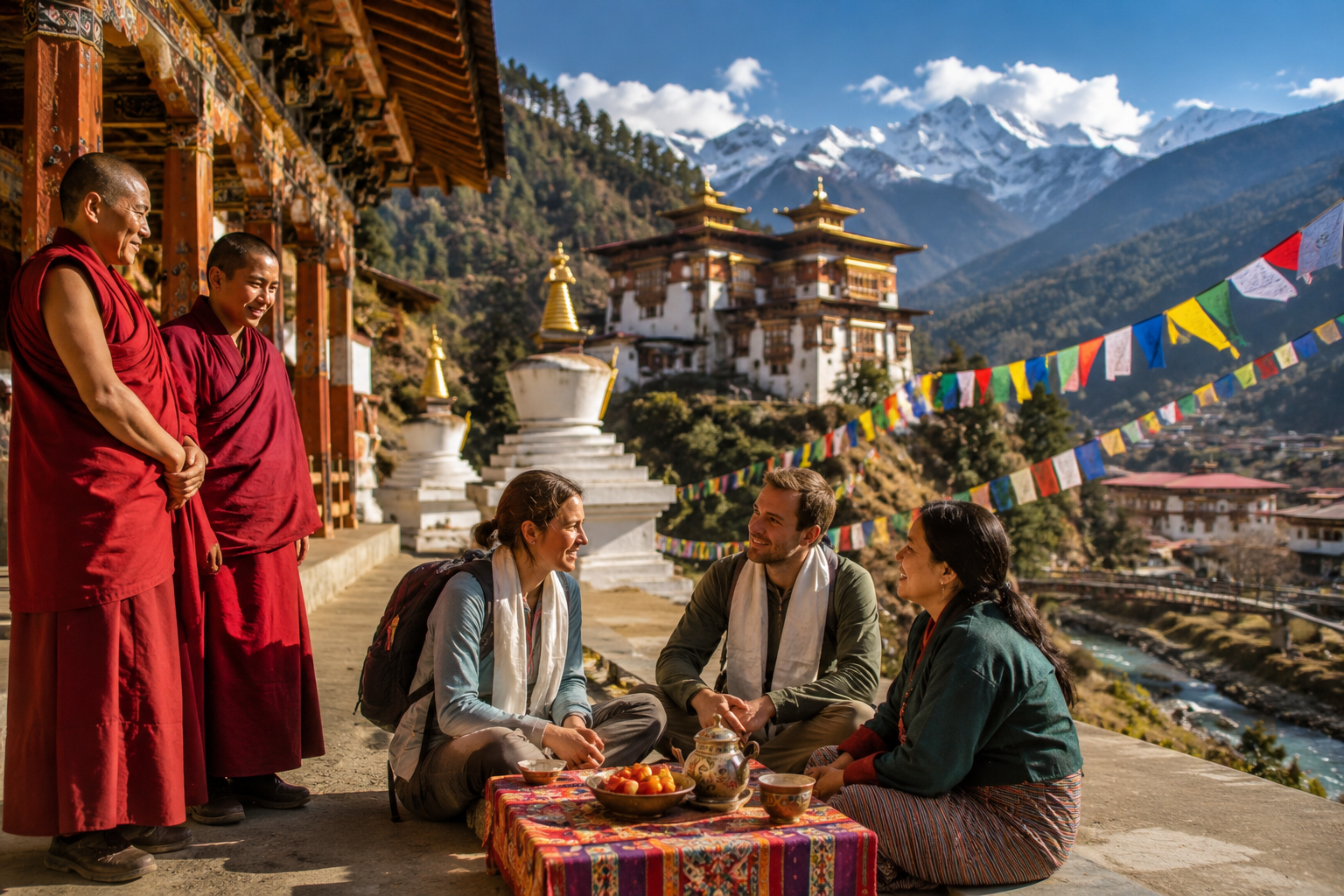
Peace, integrity, purity, humour, hospitality, generosity, and a sense of belonging—these qualities are deeply ingrained in the national character of Bhutan. Throughout any tour of the country—and particularly on this specific journey—these traits are palpable at every turn. We have meticulously designed this trip to weave together the most fascinating facets of Bhutan into a unique, experiential journey, free from the constraints of a rushed itinerary. On the contrary, the schedule offers ample opportunities for spiritual immersion and meaningful engagement with small local communities.You will discover the distinctive local form of Tantric Buddhism—a vibrant, living tradition that is inextricably woven into every aspect of daily life. Beyond the magnificent fortress-monasteries, special emphasis is placed on visiting smaller, serene temples; you will also gain insight into the philosophy behind the concept of “Gross National Happiness” and the worldviews of the people you encounter along the way. This learning takes place through direct, hands-on experience—specifically during overnight stays with local families and within monasteries, where there is abundant time for engaging conversations with your host families and the resident monks. Guided by your private expert, you will uncover the magic, mysteries, and wonders embedded in the history of this small Himalayan kingdom—a realm teeming with tales of dragons, demons, flying tigers, and the Yeti.
Throughout this journey, you will experience the sanctity of a nation that has always charted its own unique course; being a guest in this captivating land is, in itself, a profound and enriching learning experience!
Note: Tailored to your preferences, this itinerary can be fully customized to meet your specific needs. Would you prefer more time for meditation? Are you interested in practicing yoga? Do you desire more hiking opportunities or a stay in more luxurious accommodations? All of this is entirely possible!
Why This Trip?
- A unique experiential journey, specially curated by Best Travel Agents in India.
- Distinctive accommodations, such as stays in a monastery, in local homes, and at a well-maintained tented camp.
- Educational experiences gained through interactions with monks and locals.
- Ample time spent in the Bumthang Valley—the cultural heartland of Bhutan.
- A comprehensive itinerary; almost everything is included.
- A private guide and driver provided for the entire duration of your stay in Bhutan.
Today marks the beginning of your journey with "Best Travel Agents in India." Upon your arrival at Kathmandu Airport, our local representative will welcome you and escort you to a centrally located hotel, where you can check in and freshen up.
Later in the day, accompanied by your private guide, you will set out to explore Kathmandu's most significant Buddhist landmarks. First, you will visit Swayambhunath—also known as the Monkey Temple. This is the most important Buddhist shrine in the Kathmandu Valley and undoubtedly one of the most magnificent as well. The eyes of the Buddha are painted on the stupa, gazing out in all four directions. From the summit, you are treated to a beautiful panoramic view of the capital city. You will also visit the Boudhanath Stupa—an iconic symbol of Kathmandu. Standing at a height of 35 meters, it is the largest stupa in the valley. The surrounding area is home to numerous monasteries where young monks receive their education, making it a vital pilgrimage site. If time permits, you may also visit Kathmandu Durbar Square (meaning: 'Palace Square'), the very heart of the city. This square is home to a multitude of religious monuments, all constructed between the 12th and 18th centuries.
After breakfast, you will be transferred to Kathmandu Airport for a regional flight to Paro (Bhutan). The views of the mountains are spectacular, and landing on the airstrip at Paro Airport is an even more thrilling experience. Here, you will be met by your guide and driver, who will accompany you throughout your entire trip in Bhutan. The journey takes approximately one hour to reach Thimphu, the modern capital of Bhutan. Along the way, you will be treated to scenic views of snow-capped mountain ranges, terraced hillsides, and magnificent farmhouses. With a population of just 100,000, Thimphu is one of the smallest capital cities in the world. The city center features three main thoroughfares where you can find a variety of restaurants and shops. If time permits, you may visit the National Memorial Chorten in the afternoon. This Chorten was built in memory of the country's third king, Jigme Dorji Wangchuck. It is a place where many Bhutanese people gather daily to offer prayers, circumambulate the structure, and spin the large prayer wheels. Later in the afternoon, you will visit Tashichho Dzong, a magnificent monastic fortress. These Dzongs—or monastic fortresses—historically served as centers of both political and religious power. Even today, the complex houses both government offices and temples. In the late afternoon, you will observe government employees leaving the Dzong after their workday, at which point the building is opened to visitors. As you exit the Dzong, look to your left; there stands the (relatively modest) Royal Palace, the residence of the current—and fifth—King, HM Jigme Khesar Namgyel Wangchuck.
Tip: The daily flag-lowering ceremony is quite an elaborate affair. It is definitely worth witnessing.
This entire day is dedicated to sightseeing in Thimphu. After breakfast, you will begin with a stroll through the Motithang Mini Zoo, where you can observe several specimens of Bhutan's national animal—the Takin. These creatures are also known as "Bovine-Gems" or "Wildebeests." According to legend, the revered Drukpa Kunley created this animal after consuming both a cow and a goat in a single sitting, by placing the head of the goat onto the skeleton of the cow. And just like that—the Takin was born! Next, you will visit the colossal Golden Buddha statue situated on the hills overlooking Thimphu. Inside the statue, there is a temple that you are free to explore. Additionally, today's itinerary includes a visit to the 'School of Arts and Crafts'—a workshop where artists create traditional (religious) artworks—as well as a small paper-making factory. Watching a practice session of Bhutan's national sport—archery—is another highlight of the day. As you will observe, this sport is taken very seriously, although there is also ample time for light-hearted entertainment in between. If you are feeling adventurous, you can even try your hand at it yourself. But be warned: the target is set at a staggering distance of 145 meters!
You may also stop at a small market, where a wide variety of local handicrafts are available for purchase. With the guidance of your tour guide, you are free to decide for yourself how much time you wish to spend at each of these various locations.
Today, you will head east from Dochula Pass (3050m), a vantage point where—on clear days—you can behold a vast panorama of the Himalayas and where 108 stupas stand atop the ridge. Consulting with your guide and driver, you may make several stops along the way to savor the magnificent scenery. If you wish, you may stop towards the end of the drive at the small Chimi Lhakhang—the Temple of Fertility. There, you might be amused by the biography of the beloved saint Drukpa Kunley (also known as the 'Divine Madman'), whose colorful life story is depicted on the temple walls. We won't reveal too much about it here, but it is certainly an experience in itself! Also, be sure to check out the guestbook; within its pages, you will find photos of numerous visitors who were blessed with children following their visit to the temple.
You will pass through Wangdue Phodrang, where you will see the surviving remnants of the Wangdue Dzong situated against a hillside. This Dzong was almost completely destroyed in a fire in 2012. Restoration work is currently underway, though this monumental task is expected to take several years to complete. Unfortunately, fires seem to break out in the Dzongs every few years; the combination of wooden structures and the presence of a multitude of butter lamps proves to be a risky combination. The good news, however, is that many of these Dzongs are being painstakingly reconstructed with great patience and dedication.
Today's drive will lead you to your next unique experience: spending the night at a private tented camp near the Baylangdra Monastery. The camp provides sturdy sleeping tents equipped with cots and mattresses, as well as a dedicated cooking/dining tent and a toilet tent. At the monastery, you will have the opportunity to participate in the evening prayers and rituals—an experience that is sure to stay with you for a long time to come. You can still meditate here with the sadhus and offer oblations for a long, happy life. In the evening, you will enjoy dishes prepared by the cook in your tent, and you can sit late into the night by the campfire beneath the starry sky.
As you will observe this morning, the day begins at a monastery. You are welcome to join the monks in their daily rituals—including prayers, offerings, purification ceremonies, and a special prayer for good health and a fulfilling life. After breakfast, you can embark on a walk—totalling four hours—to visit another monastery. Following a late lunch, you may spend the remainder of the day at your leisure. Your guide would be happy to take you on another walk; however, if you prefer to stay back at the monastery to converse with the monks, that is perfectly fine as well. The monks are always open to engaging in meaningful conversations about their way of life, though they are often just as eager to discuss more worldly matters, such as football or volleyball.
Today, the journey continues through the Wangdue Valley and on to the Phobjikha Valley, traversing a route that passes through a section of Jigme Singye National Park. Just before reaching the Pele La Pass, you will enter the beautiful Phobjikha Valley, where you will stay at a homestay hosted by a local Bhutanese family. This offers a wonderful opportunity to experience the lives of these lovely people up close, right within their spacious farmhouses. Naturally, you are welcome to explore the valley with your guide this afternoon; however, it is also a rewarding experience to simply stay "at home" and observe how daily life unfolds within a typical Bhutanese household. Historically, livestock were housed on the ground floor; however, for reasons of hygiene, this is no longer the practice. The kitchen and living area are situated on the first floor, which typically also houses the guest rooms and the restroom. The attic serves as a space for storing and drying hay. The wood-burning stove in the kitchen acts as the very heart of these farmhouses. While there is typically no shower, a "hot stone bath" is usually available—a wooden bathtub heated by stones that have been retrieved directly from the fire. These stones radiate intense heat—it is truly a rejuvenating experience! If you wish, you can lend a hand in preparing Bhutanese specialties, such as the famous *Ema Datshi* (a very spicy "vegetable" dish consisting solely of chilies and cheese), *Momos*, or traditional butter tea. However, nothing is mandatory; anything goes!
Today, you will explore the Phobjikha Valley—hailed by many as the most beautiful valley in the Himalayas—characterized by its lush green hills. The entire valley enjoys protected status; consequently, you will find no agricultural fields here, but rather a pristine nature reserve. A small river meanders through the valley, and its lower reaches are somewhat marshy—a feature that birds absolutely adore! There are numerous options for exploring the area; you can consult with your guide to determine which itinerary best suits your preferences. For instance, you might choose to hike past the three villages of Gophu, Dogcena, and Pana, as well as visit local monasteries and farmhouses. This presents a wonderful opportunity to gain insight into rural village life. The Crane Information Center, a local school, and—of course—Gangtey Monastery are also well worth a visit. If you prefer not to do too much walking, an excellent itinerary can also be arranged for exploration by car.
You leave behind the serene beauty of Phobjikha Valley and continue your journey towards Bumthang. Allow for a drive of approximately six hours. En route, you will stop for lunch at a restaurant in Trongsa, where you will also visit the Dzong and the Watchtower. The Watchtower now houses a museum. If you feel a bit overwhelmed by the multitude of saints, kings, and historical figures—along with their various incarnations and manifestations—that are interwoven with Bhutan's cultural history, be sure to watch the short introductory film screened at the Watchtower; it provides a quick and accessible overview of Bhutan's history and legends. Additionally, the original Raven Crown—the very crown worn by the King on special occasions—can also be viewed here.
Today's final destination is Bumthang. Bumthang is, in fact, a collective name for four distinct valleys (Jakar, Tang, Ura, and Chumey) and is considered the cultural heart of Bhutan, as it is home to numerous ancient and significant monasteries. For this reason, you will spend four nights across three different locations within these valleys. Your first overnight stay will be at the simple guesthouse of the Karchu Monastery. From the veranda, you can enjoy expansive views stretching far across the valley.
Located just above your guesthouse is Karchu Monastery, offering a peaceful and spiritually enriching atmosphere, home to a community of typically 300–400 monks. In the morning, you will be welcomed by a Lama, from whom you can learn about Buddhism—an opportunity that encourages and accommodates questions and dialogue. He can share profound insights into the Buddhist perspective on suffering, life, and happiness. The Lama will also be able to guide you through meditation, with a particular focus on compassion. You will share tea with him, and he will explain the significance of the butter lamp ritual. It promises to be a unique and enlightening morning. In the afternoon, you may venture out into the valley with your guide; you can discuss with them whether you would prefer to go hiking or visit other religious sites.
Today, you will be taken to the Tang Valley, which forms an integral part of the Bumthang region. You will visit a nunnery and the village of Babzur. After a leisurely stroll through the valley, you will arrive at the Ugyencholing Palace Museum and a local apple farm. Finally, your host family will extend a warm welcome to you at their homestay.
After enjoying a hearty breakfast and bidding farewell to your host family, you set off towards the next stop of your journey. You will travel through the valley to reach Chhume Valley—both of which are constituents of the Bumthang region. Although the distance in kilometers is not great, the journey will take approximately three hours. In the afternoon, you will visit the high-altitude Zarpling Monastery. If you are in the mood for a walk, a stroll through the pine forest adjacent to the monastery is highly recommended. In any case, a short hike up to the vantage point to hang prayer flags is well worth the effort; it is a beautiful, elevated spot—and consequently, quite breezy!
Today's itinerary involves a long day of travel—returning to Punakha. Along the way, you are free to stop wherever you wish. Punakha served as the capital of Bhutan for over 300 years. The main attraction is the Punakha Dzong, which you will visit today. This massive dzong is situated at the confluence of two rivers, creating a truly magnificent spectacle. The towering white walls of the fortress were clearly designed to impress both friend and foe—and they certainly succeeded. Inside, numerous sacred relics are preserved, and the vibrant paintings are sure to leave you spellbound.
Note: If you are apprehensive about the long return journey, we can also arrange a flight from Bumthang to Paro for you—at an additional cost. These flights are operated daily by Druk Air and will save you many kilometers of travel. In that case, we would not spend the night in Punakha; however, you could still visit the town on your way out from Balilengdra.
Today, you will return to the Paro Valley, widely regarded as one of the most beautiful valleys in Bhutan. Willow trees line the roadsides, their branches swaying gently in the breeze, and you will also spot numerous apple orchards. The farmhouses here are substantial structures, featuring whitewashed walls adorned with exquisite wooden carvings. The valley floor is home to cultivated fields, while the surrounding slopes reveal a landscape of terraced farms and dense forests.
Your final overnight stay in Bhutan promises to be a special experience once again: at the Bondey Gompa Resort. This establishment is affiliated with a small hotel management school—a project with Dutch roots—where underprivileged youth receive training in hospitality services. At the restaurant situated amidst the fields in Bongde village near Paro, you are helping to support the students' education and expenses, while simultaneously being served magnificent food prepared by a group of somewhat shy young men and women. The food is prepared with great care—a quality you can truly taste. You are welcome to peek into the kitchen, and the students enjoy the opportunity to practice their English. The rooms are simple, yet clean and tidy.
Note: The Lungchutse hike is also an option for today. This trek leads you from Dochula Pass, winding through a rhododendron forest, to a monastery perched atop a mountain peak. The hike takes approximately three hours.
Today, you will visit one of Bhutan's most famous sites: Taktsang, also known as the Tiger's Nest. You will cover the initial stretch by car, but the final ascent will be undertaken on foot. Perched precariously on a cliff face at an altitude of 800 meters, this site is not only the country's most renowned landmark but also its most spectacular. It was built on the very spot where, in the 8th century, Guru Rinpoche landed after flying in on the back of a pregnant tigress. Guru Rinpoche—also known as Padmasambhava—is revered as an incarnation of the Buddha and the figure who introduced Buddhism to Bhutan. He meditated in a cave at this location for three months. The present-day monastery is built around this very cave. You can visit the various temples located here, after which you will descend to the teahouse for lunch. Afterward, the descent back to the point where your driver is waiting will take just under an hour. This afternoon, you may choose to visit Kyichu Lhakhang—one of Bhutan's oldest temples—or the Paro Museum, housed within a magnificent architectural structure.
After breakfast, you will be transferred to Paro Airport. Here, you will bid farewell to your Bhutanese guide and driver and check in for your regional flight back to Kathmandu. You will then be transferred to your hotel in Patan. Patan is one of the three royal cities of the Kathmandu Valley; situated just 2 kilometers south of Kathmandu, it has today effectively merged into the greater Kathmandu urban area. It is generally less crowded and hectic than Kathmandu itself, which is why we have chosen to conclude our trip here. Should you wish to explore Kathmandu, it is merely a short taxi ride away. Much like Kathmandu, Patan features its own Durbar Square—a site that sustained relatively less damage during the earthquake of 2015. The streets are bustling with activity, creating a pleasant and peaceful atmosphere. There are also numerous small shops and craft workshops here, so if you are looking to purchase souvenirs, you are sure to find exactly what you are seeking.
Depending on the scheduled departure time of your return flight, you may have some free time available in Patan. Optionally, we can arrange a scenic flight over the Himalayas in a small aircraft (approximately 1 hour; price available upon request). This excursion is shared with other travelers. It serves as a magnificent conclusion to your tour, and you will undoubtedly be left awestruck by the breathtaking views! You will be transferred to Kathmandu Airport in good time for your return flight. This marks the conclusion of your journey with Best Travel Agents in India. Note: Your hotel room is not reserved for your use for the entire day. Should you desire, we can arrange a day-use room or a late check-out; the additional cost for this service is available upon request
- Assistance during your trip (available 24 hours)
- Overnight stays as per the itinerary
- Meals as per the itinerary
- Regional flights: Kathmandu – Paro and return
- Airport taxes and levies
- Transfers and transportation during sightseeing via private car with a dedicated driver
- Expert English-speaking guide (traveling with you in Bhutan)
- All services specified in the itinerary above
- Specified sightseeing attractions and associated entrance fees
- Bhutan Visa (valued at USD 50 per person)
- A comprehensive information package accompanying your travel documents, including country information, vouchers, e-tickets, and a hotel list.
- Enough water in the car / coach
- All meals in Bhutan
- Any International flight.
- Nepal Visa costs (approx. € 62.50 per person for 30 days, or USD 45 at the airport; in both cases, please apply prior to departure)
- Optional excursions and entrance fees
- Other meals (Lunch and Dinner in Nepal)
- Optional early check-in / late check-out
- Gratuities to driver, guide, hotel staff etc.
- Travel and cancellation insurance
- Anything else that is not mentioned in the “Price Includes” section.