
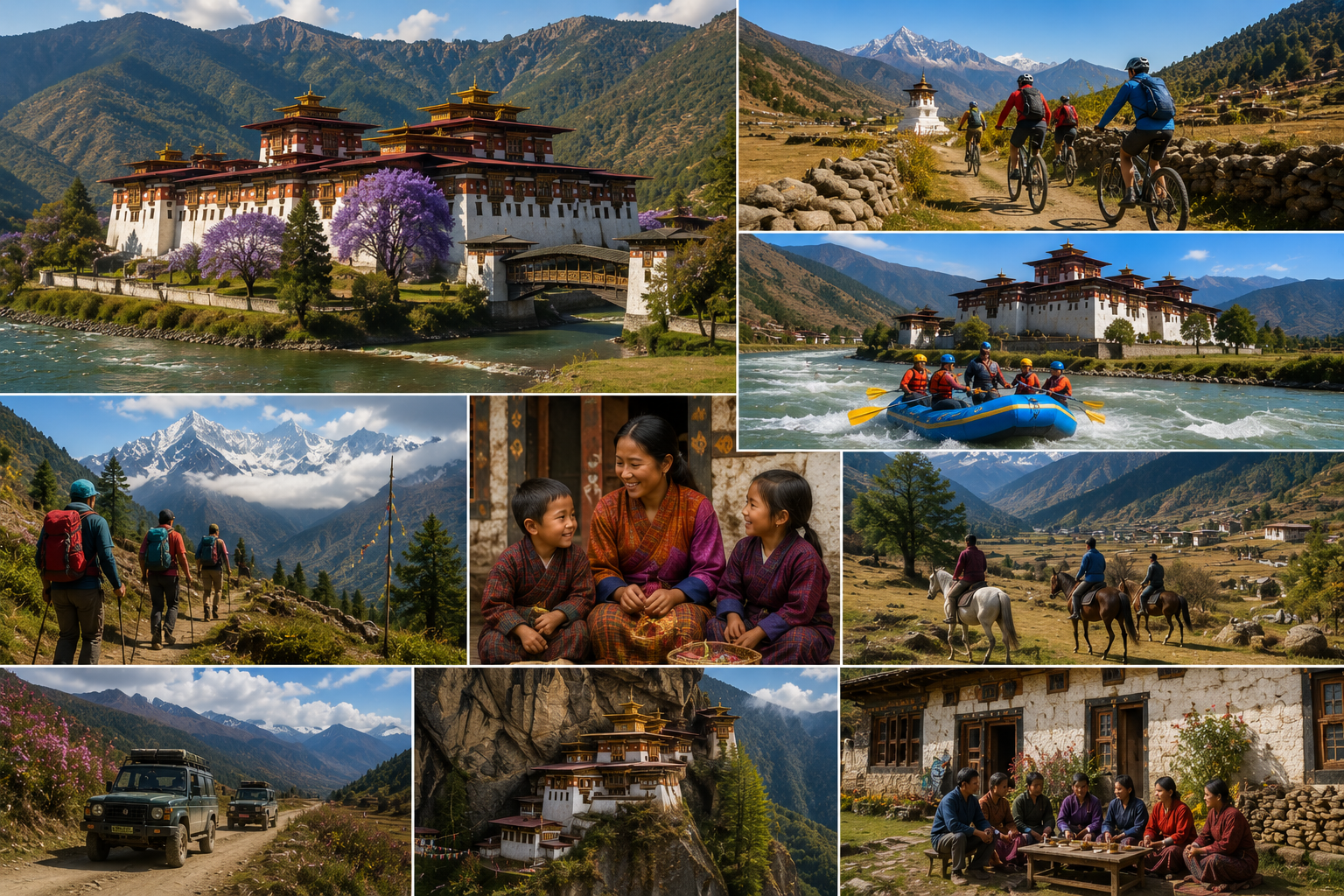
Have you heard many wonderful stories about Bhutan? Would you like to explore the country, but not in the traditional way? Would you prefer something a bit more active? Then take a look at this trip. On this journey, you will set out in a 4×4 vehicle accompanied by a guide and a driver; however—whenever possible (and this happens often)—you will swap the jeep for a raft, a mountain bike, or a horse, or simply proceed on foot. The region boasts beautiful hiking trails, and the ancient trade routes are absolutely perfect for mountain biking. Even on the ‘highways,’ traffic is so sparse that you can enjoy exhilarating descents to your heart’s content. And how does rafting near the Punakha Dzong sound? Or perhaps a horseback ride through the Bumthang Valley? Throughout this trip, there is also ample time to interact with locals and explore the magnificent fortress-monasteries. Furthermore, you will spend two nights at a homestay, allowing you to experience firsthand just how kind and welcoming the Bhutanese people truly are. It’s Bhutan—but with a unique twist!
Why this trip?
- A unique and distinctive journey where you explore the country in a best way.
- A wide range of activities: hiking, cycling, archery, horseback riding, rafting—you won't get bored!
- All transportation throughout the entire trip is included, provided via private car with a dedicated driver
- The services of an expert local guide (English-speaking) in Bhutan are included.
- Spend a few nights in homestays, staying "among the locals."
- Spend a few nights in a luxury camp situated in a spectacular location.
- The sample itinerary can be flexibly customized; please inquire about the possibilities.
- A truly comprehensive trip: all your meals in Bhutan are also included
Today marks the beginning of your trip with Best Travel Agent in India. Upon your arrival at Kathmandu Airport, our local representative will be there to welcome you. Subsequently, you will be transferred to your hotel in the city. You may spend the remainder of the day at your leisure. You can choose to rest and recover from your flight or explore the city on your own.
Accompanied by your English-speaking guide, you will visit Kathmandu’s key highlights today. For instance, you will stop at Durbar Square (meaning: 'Palace Square'). This site serves as the beating heart of Kathmandu and remains one of its most significant attractions. The square is home to numerous religious monuments, all constructed between the 12th and 18th centuries. The most renowned among them is the Kumari Bahal, the residence of the living child goddess, Kumari. Many beautiful structures were destroyed—and many others damaged—during the earthquake of 2015; restoration efforts are expected to take a considerable amount of time. Afterward, you will proceed to Boudhanath (Buddha), located approximately 6 kilometers east of Kathmandu. Standing 35 meters tall, this is the largest stupa in the valley. Here, too, you will encounter the four painted eyes of the Buddha. The surrounding area is dotted with numerous monasteries where young monks receive their education. It also serves as a vital pilgrimage site. You will also visit the Pashupatinath Temple, one of the most important Hindu temples in the world. It houses the sacred Lingam, the symbolic representation of Lord Shiva. Non-Hindus are not permitted to enter the inner sanctum of the temple; however, even without entering the shrine itself, you will gain a profound insight into the rituals and customs of worship practiced there. At Pashupatinath, you may also observe traditional cremation ceremonies taking place along the banks of the sacred Bagmati River. Following these visits, you will return to your hotel.
After breakfast, you will be transferred to Kathmandu Airport for a regional flight to Paro. The views of the mountains are spectacular, and landing on the airstrip at Paro Airport is an even more thrilling experience. Here, you will be met by your guide and driver, who will accompany you throughout your entire trip in Bhutan. The journey takes approximately one hour to reach Thimphu, the modern capital of Bhutan. Along the way, you will be treated to beautiful vistas of snow-capped peaks and slopes dotted with large, traditional farmhouses. With a population of just 100,000, Thimphu is one of the smallest capital cities in the world. The city center features three main thoroughfares where you can find a wide variety of restaurants and shops. If time permits, you may visit the Memorial Chorten and Tashichho Dzong in the afternoon. The Memorial Chorten was built in memory of the country's third king, Jigme Dorji Wangchuck. It is a place where many Bhutanese people gather daily to offer prayers, circumambulate the monument, and spin the large prayer wheels. Tashichho Dzong is a magnificent monastic fortress. These *dzongs* (monastic fortresses) historically served as centers of both political and religious power. To this day, the government offices and the temple are both housed within its premises. In the late afternoon, you will observe government employees leaving the Dzong after their workday, at which point the building is opened to visitors. As you exit the Dzong, look to your left; there stands the (relatively modest) Royal Palace, the residence of the fifth and current king, HM Jigme Khesar Namgyel Wangchuck.
Tip: The daily flag-retreat ceremony is accompanied by a fascinating ritual. Definitely worth seeing!
The morning begins with a beautiful, leisurely walk of about three hours at Kuensel Phodrang, where you will also encounter a massive golden statue of the Buddha. You descend gradually into the valley, concluding your walk at the Changangkha Monastery. After lunch, it is time for Bhutan’s national sport: Archery! It is a spectacular sight. The target is positioned at a staggering distance of 145 meters. You can barely discern whether or not you have hit it—yet, some archers seem remarkably confident in their shot the moment it is released. The game is played between two large teams, and the matches are accompanied by singing and dancing. Players are even permitted to distract their opponents—whether by singing songs designed to disrupt their focus or by waving their arms within their line of sight. While this sport is taken very seriously, there is certainly plenty of room for fun and revelry. If you wish, you can even try your hand at hitting the target yourself.
In the evening, you will have the opportunity to immerse yourself even deeper into Bhutanese culture, as you have been invited to dine at the home of a local family. As you savor traditional dishes and engage in conversation with the family, you will learn a great deal about Bhutanese traditions and culture!
The journey to Punakha takes approximately 3 hours. This route leads you to Dochula Pass (3050m), where—on clear days—you can behold a vast expanse of the Eastern Himalayas, and where 108 stupas stand atop the ridge. From here, you will embark on a hike to the higher-altitude Lungchutse Monastery (3400m). This is a beautiful ascent totaling 3 hours, offering—in clear weather—stunning vistas of the Himalayan range and forests of rhododendrons. These bloom during the months of April and May, creating a truly spectacular display of color!
After lunch, upon returning to Dochula Pass, you will be taken to Chimi Lhakhang—the Temple of Fertility. There, you may be intrigued by the life story of the beloved saint Drukpa Kunley (also known as the 'Divine Madman'), whose colorful life is depicted on the temple walls. We won't reveal too much more, but it is certainly an experience not to be missed!
Following this visit, you will be transported to Punakha. Punakha served as the capital of Bhutan for over three centuries and, consequently, holds a pivotal role in Bhutanese cultural history. Punakha sits at an elevation of 'only' 1,350 meters; as a result, the weather here remains remarkably mild, even during the winter months.
After breakfast, you will visit the Khamsum Yulley Temple—a pleasant walk of about an hour and a half, winding through rice fields and pine forests. This intriguing temple was commissioned by the mother of Bhutan's fifth king and is said to bring peace to the world. Inside the temple, you will discover a variety of frescoes, statues, and paintings.
Your next adventure begins at the river just below the Khamsum Yulley Temple: under professional guidance, you will embark on a spectacular rafting trip down the Mo Chhu River. In about an hour, you will arrive at Punakha's main attraction: the Punakha Dzong. This massive dzong is situated at the confluence of two rivers, creating a truly magnificent spectacle. Accompanied by your guide, you will tour the interior of this dzong. The colossal white fortress walls were clearly designed to impress both friend and foe—and they certainly succeed. Inside, numerous sacred relics are housed, and the sheer abundance of colorful artwork is enough to make your head spin.
The next drive is a bit rugged and takes approximately 4 hours. But what a reward awaits you at the end! Just before reaching the Pele La Pass, you will turn off into the beautiful Phobjikha Valley. Here, you will camp in a luxury camp for the coming nights. You will have a spacious tent furnished with real beds. And yes, a private cook accompanies you to ensure that you lack for nothing. The beauty of camping lies in the opportunity to spend the night in the most beautiful and tranquil locations.
In the afternoon, you will hop onto a mountain bike for a scenic ride through the valley. Many consider the Phobjikha Valley—with its lush green hills—to be the most beautiful valley in the entire Himalayas. The entire valley has been designated as a protected area.
Therefore, you won't find any agricultural fields here, but rather only nature reserves. A small river flows through the valley, and the lower section is somewhat marshy. The birds absolutely love it!
Tip: Cycling enthusiasts can also enjoy a bike ride today from Lawala Pass (3200m) down to their campsite in the Phobjikha Valley (approximately 1.5 hours).
Starting from Gangtey Monastery, today you will set out on foot, passing through the three villages of Gophu, Dogsena, and Pana, as well as local monasteries and fields. This is a wonderful opportunity to get a firsthand glimpse of village life. In Jangchub village, you will visit the monastery before descending back into the valley. In winter, a large flock of rare Black-necked Cranes makes this valley its winter home. Even if you happen to visit outside of the winter months, you can still learn more about these birds by visiting the Black-necked Crane Information Centre. You will once again spend the night at your private campsite. Tip: At the Crane Information Centre, you can meet Karma—an injured crane. She was likely attacked by a dog, and there is little hope that she will ever fly again. While her companions migrate back to Tibet every spring, she remains at the Information Centre, where she receives care. Naturally, you are welcome to make a donation here to support her shelter, recovery, and ongoing care.
You bid farewell to the Phobjikha Valley and continue your journey toward Bumthang. Expect a drive of approximately 6 hours. Naturally, stops can also be made along the way—such as at Pele La Pass (3400m)—from where you can enjoy a magnificent view of the mighty Mount Jomolhari in the Himalayas. En route, you will stop for lunch at a restaurant in Trongsa. Here, you will also visit the Dzong and the Watchtower. The Watchtower currently houses a museum. If you feel a bit overwhelmed by the multitude of saints, kings, and historical figures—along with their various incarnations and manifestations—associated with Bhutanese cultural history, be sure to watch the short introductory film screened at the Watchtower; it will instantly provide you with a clear overview of Bhutanese history and mythology. Additionally, the original Raven Crown—worn by the kings on special occasions—can be viewed here.
Today's final destination is Bumthang. Bumthang is, in fact, a collective name for four distinct valleys: Jakar, Tang, Ura, and Chumey. Tonight, you will be staying in the first of these valleys—Chumey—at a small, exceptionally tranquil hotel that offers magnificent views of the valley.
You will be driven by car to Tharpaling Monastery, situated on a mountain ridge (3600m). After admiring the views of the wild hills, you will be invited inside the monastery to share tea and conversation with one of the lamas who have resided there since 1352. A truly unique experience! After enjoying your tea—and perhaps listening to some words of wisdom from the lama—you will descend from the monastery on your mountain bike, following an old hiking trail that winds.alternately through pine forests, rhododendron groves, and occasional rocky terrain. In approximately two hours, you will descend from an elevation of 3600 meters to 2800 meters. With a bit of luck, you might even catch a glimpse of Gangkhar Puensum (7541m). If you reach the paved road, your driver can pick you up from there; however, those who haven't had their fill of riding yet can continue cycling all the way to Jakar. Although it is a paved road, traffic here is very light. If you enjoy fast-paced turns, you will find this stretch particularly exhilarating. The final section leading into Jakar village runs right alongside the river. This is where you will be staying for the next two nights: a friendly and atmospheric mountain lodge.
Today, you will explore the Bumthang Valley in a very special way: on horseback! This ride proceeds at a leisurely pace and is suitable even for beginners. Upon arrival at the ranch, you will receive a brief orientation; after getting acquainted with your horse in the pasture near the riding school, you will set off on a trek to the village of Tandidingang. The beautiful scenery and agricultural fields offer plenty of photogenic moments. Naturally, there will be ample time to stop along the way, as this is not a race. Immerse yourself in local village life—where time seems to stand still—and return through the valley, passing by a cattle farm along the way. This ride takes approximately 3.5 hours. In the afternoon, there is still ample time to visit the Ugyencholing Museum, a historic palace.
Note: If you do not enjoy horseback riding, we can substitute the riding portion of today's itinerary with a scenic walk instead
To spare you the long overland journey back to the west, we have included a domestic flight from Bumthang to Paro in today's itinerary. You will fly back to Paro from Bumthang's small airstrip, accompanied by your guide. Upon arrival in Paro, your driver will be waiting to transport you to the Haa Valley. Once atop the pass that separates the valleys, you can stroll along the mountain ridge; if you still have the energy, you can mountain bike all the way down into the Haa Valley, where you will check into a homestay. This accommodation is situated within one of the region's large traditional farmhouses. Historically, livestock were housed on the ground floor; however, for reasons of hygiene, this practice is no longer followed. The kitchen and living area are located on the first floor—which typically also houses the guest rooms and restrooms—while the attic serves as a space for storing and drying hay. The wood-burning stove in the kitchen acts as the heart of these traditional farmhouses. While there is usually no conventional shower, a "hot stone bath" is available—a wooden bathtub heated by stones that have been heated in a fire. These stones radiate an intense amount of heat. A Fun Experience!
Haa Valley was opened to tourism only in 2002, and despite being a relatively short distance from Paro, it receives very few visitors. Here, you will visit a unique site: the small Juneydrak Hermitage, perched high on a mountain slope. The walk takes you through a small village and a grove of rhododendrons. The final stretch of the hike is quite adventurous, though a rope is provided for support. If you are lucky, the resident Lama will open the door, allowing you to step inside and view the small shrine.
The afternoon program features a culinary adventure. You will join a local cook to prepare “Huente”. This is a local specialty—a snack somewhat similar to the Tibetan “momo”, but featuring a crispy crust reminiscent of the Indian “samosa”. Preparing this dish alongside a local cook—and, of course, enjoying the delicious result—is a truly delightful experience! You can spend the rest of the afternoon with a local family, perhaps watching an archery competition or a training session.
Departing from the Haa Valley, you reach the summit of Chele La Pass (3810m) in approximately one hour. Wherever you look, you will see prayer flags fluttering in the breeze, and on a clear day, you are treated to a magnificent view of Mount Jomolhari (7314m). Here, the mountain bikes are unloaded, and you cover the remainder of the journey by bike, descending down the slopes on the other side of the pass. It is a beautiful route featuring numerous winding turns as it winds its way downwards. During the winter months, the higher elevations remain blanketed in snow and ice—a truly spectacular sight. Although this route follows the main road, traffic here is extremely light.
Gradually, as you enter the Paro Valley, you return to civilization. Here, you will see traditional farms, terraced fields, and orchards. You arrive at Bongde village, where the majority of the residents make their living through farming. Here, you will enjoy lunch at a unique restaurant. It is affiliated with a hotel school—a project with roots in the Netherlands—that offers underprivileged youth the opportunity to receive training in hotel services. Thus, you are directly contributing to the education of these young people as they—some of them a bit shy—serve you a delightful and surprising lunch. The food is prepared and presented with great care and attention to detail—a quality you can truly taste in every bite. With your appetite satisfied, you may choose to cycle the final stretch to Paro, or your driver can transport you by vehicle. In the afternoon—for instance—you might head into Paro town to shop for souvenirs, or visit the museum housed within the Watchtower or the Paro Dzong. Alternatively, you can 'save' these activities for tomorrow. You can discuss your preferences with your guide on the spot.
Today, you will visit one of Bhutan's most famous landmarks. You will travel by car to Taktshang, from where you will begin your hike up to the Tiger's Nest. Perched precariously on a cliff face at an altitude of 800 meters, this site is not only the most famous but also one of the most spectacular places in the country. It was built on the very spot where Guru Rinpoche landed in the 8th century after flying in on the back of a pregnant tigress. Guru Rinpoche—also known as Padmasambhava—is revered as an incarnation of the Buddha and the figure who introduced Buddhism to Bhutan. He vanquished several demons here and meditated in a cave for three months. The current temple complex is built around this very cave. You can visit several religious shrines here before descending to the teahouse, where you will have lunch. Afterward, the descent back to the point where your driver is waiting will take approximately one hour. This afternoon, you may visit Kyichu Lhakhang, one of the oldest temples in Bhutan.
Say goodbye to your Bhutanese guide and driver, and take your return flight to Kathmandu today, and take your flight back to Kathmandu today. To ensure a safe connection for your return flight to onward destination, or if you wish to staying overnight in Patan with an additional price. Patan is one of the three royal cities; located just 2 kilometers south of Kathmandu, it has nowadays effectively merged into the greater Kathmandu urban area. Compared to Kathmandu, it is less crowded and hectic, which is why we decided to conclude our trip here. From your accommodation, you will enjoy a view of Durbar Square. If you wish to visit Kathmandu, it is just a short taxi ride away. Like Kathmandu, Patan also boasts a Durbar Square—one that sustained relatively less damage during the 2015 earthquake. The streets are bustling with activity, and the atmosphere is pleasant and peaceful.
There are also many small shops and craft workshops here, so if you are still looking to purchase souvenirs, you are sure to find exactly what you are looking for.
You will be transferred to the airport for your return flight. This marks the conclusion of your trip with Best Travel Agents in India.
Note: The hotel room is not available to you for the entire day (on day 16). If you wish, we can arrange a day room or a late check-out; this service is available upon request for an additional charge.
- Traditional welcome on arrival at Kathmandu (Nepal) & Paro (Bhutan).
- Assistance during your trip (available 24 hours).
- Regional flights: Kathmandu – Paro and return
- Domestic flight: Bumthang (Jakar) – Paro
- Airport taxes and fees
- All overnight stays as per the itinerary
- All meals as per the itinerary
- All services specified in the itinerary above
- Scheduled transfers and transportation by private car with a driver during sightseeing
- Entrance fees for scheduled sightseeing sites
- An expert English-speaking guide (accompanied by a guide in Bhutan)
- Bhutan Visa (Cost: 50 USD per person)
- Comprehensive information package including country details, vouchers, e-tickets, and a hotel list, provided alongside your travel documents
- Enough water in the car.
- Any international flight (Origine – Kathmandu and return.
- Nepal Visa costs (Approximately € 62.50 per person for 30 days, or 40 USD upon arrival at the airport—in either case, please apply prior to departure)
- Additional meals (Lunch and dinner in Nepal)
- Optional excursions and entrance fees
- Optional early check-in / late check-out
- Gratuities (Tips) to driver, guide, hotel / camp satff/ homestay etc.
- Travel and cancellation insurance
- Anything else that is not mentioned in the "Price Includes" section