
About This Trip
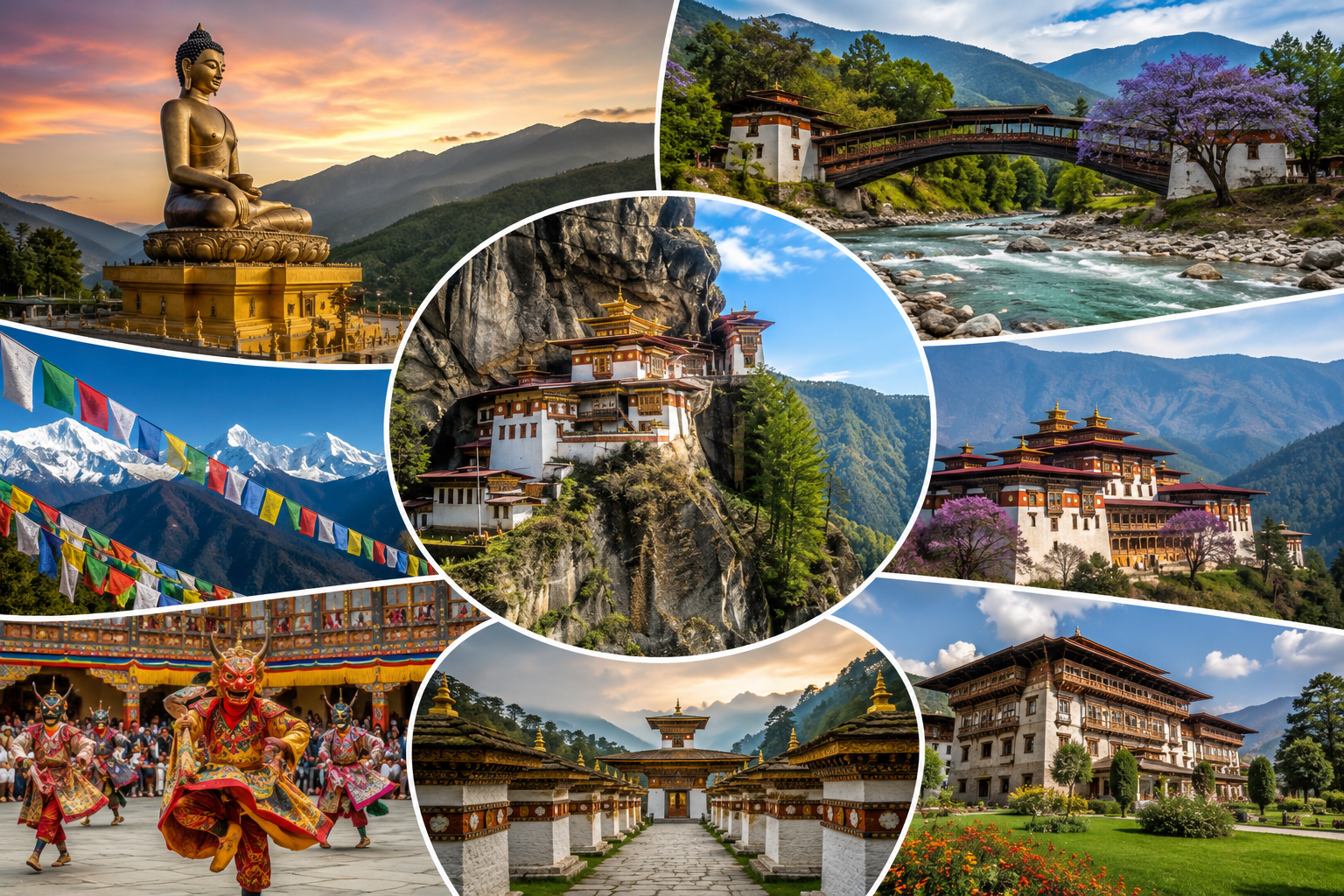
Would you like to fully experience one of Asia’s most unique destinations? The 16-day ‘Entire Bhutan Trip’ is the perfect choice for numbers of travellers. You will journey across the country from west to east, passing through some of its most beautiful valleys—such as Phobjikha and Bumthang—along the way. During visits to Dzongs and monasteries in places like Paro, Thimphu, Punakha, and Trongsa, you will gain deep insights into the country’s cultural history, as well as its many legends and folklore. Naturally, a visit to Bhutan’s most famous monastery—the Tiger’s Nest—is an absolute must. This trip also takes you to the country’s lesser-known eastern region, where you will welcome warm-hearted locals’ population. This fully organized tour offers a comprehensive introduction to this mystical kingdom of the Himalayas.
Why choose this trip?
- Experience the must-see highlights of the West alongside the hidden gems of the East
- A comprehensive itinerary; almost everything is included.
- Overnight stays in comfortable, mid-range hotels.
- More luxurious hotel options are also available at an additional cost.
- All transfers are conducted by private car with a dedicated driver.
- An English-speaking guide will accompany you throughout your stay in Bhutan.
- The package includes sightseeing excursions, entrance fees, all meals, and the Bhutanese visa
- You will discover not only monasteries and fortresses but also breathtaking natural landscapes. To experience the real Bhutan, you will meet the local people and learn about their unique customs.
- This program is flexible.
- The trip can be extended to include a visit to India.
Today, your journey begins with a flight from Delhi to Paro. The landing at Paro International Airport is renowned as one of the most spectacular landings in the world. The airport is nestled amidst the mountains, offering breathtaking views during the descent. Upon your arrival at Paro Airport, you will be welcomed by your guide and driver, who will accompany you throughout the entire trip. You will be transferred to your hotel—located just a short distance from the airport—where you will be staying for the coming nights.
If time permits, you may head out with your guide to explore the sights of Paro and the surrounding area. For instance, this afternoon you could visit Drukgyel Dzong, the ruins of a fortress from where Tibetan invasions were once repelled. However, if you prefer to rest for a while to recover from your flight, that is also an option.
Tip: The spa at Tashi Namgay Resort can arrange a hot stone bath for you (at an extra charge). Here, the water in a wooden bathtub is heated using glowing hot stones retrieved from a fire with tongs. It offers a wonderfully relaxing herbal bath experience with views of the river!
Today, you will explore Paro and its surrounding region. First, you will visit Kyichu Lhakhang, one of the oldest temples in the Kingdom. After lunch, you will proceed to Ta Dzong, which was converted into a museum in 1968. Here, you will discover an extensive collection of ancient art and artifacts. The museum is housed within an old defensive watchtower. From the museum, you can enjoy a magnificent panoramic view of the Paro Valley. As you make your way downhill, you pass by Rinpung Dzong, where you get a fine impression of Bhutanese architecture.
Today, you will visit one of Bhutan's most renowned sites. You will travel by vehicle to Taktshang, from where you will begin your uphill trek to the Tiger's Nest. Perched precariously on a cliff face at an altitude of 800 meters, this site is not only the country's most famous landmark but also its most spectacular. It was built on the very spot where, in the 8th century, Guru Rinpoche landed after flying in on the back of a pregnant tigress. Guru Rinpoche—also known as Padmasambhava—is revered as an incarnation of the Buddha and the figure credited with introducing Buddhism to Bhutan. He vanquished several demons here and meditated in a cave for three months. The present-day monastery is built around this very cave. You can visit several religious shrines here before descending to the teahouse, where you will have lunch. Afterward, your driver will be waiting to take you to the Haa Valley; the drive there takes just under an hour.
The Haa Valley was opened to tourism only in 2002, and despite its close proximity to Paro, it receives very few visitors. In the Haa Valley, you have the option of staying in a homestay rather than a standard mid-range hotel. Staying on a farm with a Bhutanese family offers a truly unique and special experience
In Haa, you will visit Wangchuk Dzong, as well as Lhakhang Karpo and Lhakhang Nakpo (the White and Black Temples, respectively); the latter dates back to the 7th century. Legend has it that King Songtsen Gampo released a black pigeon and a white pigeon to determine the locations for the temples. The black pigeon landed slightly to the north of the white pigeon, at the site of the existing temples. The temples were named Nagpo (Black) and Karpo (White) because they were built at the very spot where the pigeons had alighted.
In the afternoon, the journey to Thimphu continues from the Chele La Pass (3,899 meters). En route—weather permitting—you will be treated to magnificent views of the towering Himalayan peaks of Jomolhari and Jichu Drake. With a population of just 100,000, Thimphu ranks as one of the smallest capital cities in the world. The city center features three main thoroughfares where you can find numerous restaurants and shops; however, there are no traffic lights—making Thimphu the only capital city in the world without them. You will be staying here for the coming nights.
Today is dedicated to exploring the capital city, Thimphu. You will begin the day at the Memorial Chorten, a monument built in memory of the country's third king, Jigme Dorji Wangchuck. It is a place where many Bhutanese people come daily to offer prayers, circumambulate the structure, and spin the large prayer wheels. Next, you will visit the colossal Golden Buddha statue situated in the hills overlooking Thimphu. Inside the statue, there is a temple that you are welcome to enter. Additionally, today’s itinerary includes visits to the Changangkha Monastery, the National Institute of Traditional Medicine (which houses a museum), the School of Arts and Crafts, the Textile Museum, the Folk Heritage Museum, a nunnery, and a local market where a wide variety of handicrafts are available for purchase. With guidance from your guide, you are free to decide for yourself how much time you wish to spend at each of these various locations. It would be fitting to conclude the day with a visit to Tashichho Dzong—a magnificent monastic fortress. Historically, these Dzongs (monastic fortresses) served as centers of both political and religious power. Even today, the complex houses both government offices and temples. In the late afternoon, you will observe officials leaving the Dzong after their workday, at which point the building is opened to visitors. As you exit the Dzong, be sure to look to your left; located here is the (relatively modest) Royal Palace, the residence of the current and fifth King, HM Jigme Khesar Namgyel Wangchuck.
Tip: The daily Flag Retreat Ceremony is quite an elaborate affair. It is definitely a sight worth seeing!
The journey continues towards Punakha; it is an approximately 3-hour drive. This route takes you over the Dochula Pass (3,050 meters), where—on clear days—you can behold the magnificent range of the Himalayas, and where 108 stupas adorn the mountain slopes. In consultation with your guide and driver, you may stop at various points along the way to enjoy the captivating scenery. Do not forget to make a brief stop at the Lamperi Botanical Park to catch a glimpse of the country's rich flora and fauna.
After lunch, you will visit Chimi Lhakhang—also known as the 'Temple of Fertility.' Here, you will be captivated by the biography of the beloved Saint Drukpa Kunley (also referred to as the "Divine Madman"); his extraordinary life story is depicted on the temple walls. We won't reveal too much about it here, but it promises to be a truly memorable experience!
Following this, you will be taken to Punakha. Punakha served as the capital of Bhutan for over three centuries and played a pivotal role in shaping the culture of modern Bhutan.
The highlight of this morning's itinerary is Punakha's main attraction: the Punakha Dzong. This magnificent fortress is situated at the confluence of two rivers, presenting a scene of exquisite beauty and charm. Its massive white walls were clearly designed to impress both friends and foes—and in this regard, they have certainly succeeded. Inside, numerous sacred artifacts are meticulously preserved, and you will undoubtedly be awestruck by the abundance of colorful murals (wall paintings) adorning its interiors. Following this journey, the route continues through the Wangdu Valley towards the Phobjikha Valley. Along the way, you will catch sight of the ruins of the Wangdu Dzong, perched on a hillside slope. This Dzong was almost completely destroyed in a fire that broke out in 2012. Restoration work is currently underway, although this monumental task is expected to take several more years to complete. Unfortunately, incidents of fires breaking out in Dzongs occur every few years. The combination of wooden structures and a large number of burning butter lamps creates a rather hazardous situation. However, the good news is that many Dzongs (fortresses) are being rebuilt with great patience and dedication. Just before reaching the Pele La Pass, you will turn off towards the magnificent Phobjikha Valley, where you will check in at a cozy, small, family-run hotel. Naturally, you are free to explore the valley with your guide this afternoon.
Tip: In the Phobjikha Valley, it is also possible to opt for a "homestay"—that is, staying with a local Bhutanese family in their own home. This offers a wonderful opportunity to get a close look at the lives of these warm-hearted people and to experience how they live within their spacious, traditional farmhouses.
Today, you will explore the Phobjikha Valley—described by many as the most beautiful valley in the Himalayas—known for its lush, gently sloping hills. The entire valley holds protected status; consequently, you will not find cultivated fields here, but rather a pristine natural sanctuary. A small river meanders through the valley, and the lower-lying areas are somewhat marshy—a habitat that birds absolutely adore! This region offers numerous options for walking and hiking; you can consult with your guide to determine which route best suits your preferences. For instance, you might choose a trail that winds through the three villages of Gophu, Dogsena, and Pana, as well as past local monasteries and farmhouses. This presents a wonderful opportunity to catch a glimpse of rural life in Bhutan. Additionally, the Crane Information Center, a local school, and—of course—Gangtey Monastery are all places well worth a visit.
You leave the Phobjikha Valley and continue your journey toward Bumthang. The drive takes approximately six hours. Along the way, you will stop for lunch at a restaurant in Trongsa, where you will also visit the *dzong* and the watchtower. The latter now houses a museum. If the multitude of saints, kings, and historical figures—along with their incarnations and various manifestations! —associated with Bhutan’s cultural history seems daunting, be sure to watch the short introductory film screened at the watchtower; it will quickly familiarize you with the iconic figures of Bhutanese history and mythology. You can also admire the original "Raven Crown" there, worn by the kings on special occasions.
Here is your final destination: Bumthang. In reality, Bumthang refers to four distinct valleys: Jakar, Tang, Ura, and Chume. The lodge where you will be staying is located in Jakar. It is a charming, comfortable, and welcoming family-run hotel that offers a variety of local products. After all, the Bumthang Valley is renowned for its excellent cheese—and don’t forget to sample the locally brewed Red Panda beer!
Today, a magnificent half-day hike awaits you. You will visit three temples and a monastery, including Jambay Lhakhang and Kurjey Lhakhang. At Kurjey, the resident caretaker kneels before the altar hundreds of times a day—a practice that has left clearly visible knee imprints on the wooden floor. You will also have the opportunity to see the famous imprint of Guru Rinpoche's (the Second Buddha) body—etched into a rock and enshrined within the altar. There is also a cave on the premises—where, if one has committed grave sins, there is a risk of getting stuck—offering visitors a chance to seek liberation from their suffering and sins. To reach the monastery, you must cross a suspension bridge to the other side of the river. You can enjoy a picnic lunch by the riverside, amidst a serene and pleasant atmosphere. The trail is mostly flat, making the walk relatively unexacting. Should you find this hike too strenuous, we can arrange alternative activities for you for the following day. At the local cheese factory, you can compare the 'Gouda cheese' produced there with its authentic counterpart; you can also savor the local 'Peach Wine' or the in-house brewed 'Red Panda Weizen Beer.' In the afternoon, you will visit the historic 'Wangdicholing Royal Palace,' the 'Dzong' (fortress), and the vast 'Karchu Monastery' (home to 300 to 400 monks). While there, if you wish, you may sit down for tea and conversation with a 'Lama' (Buddhist monk)—a truly unique and enlightening experience!
Today, you will set out on an excursion to the 'Tang Valley'—a valley that also falls within the Bumthang region. En route, you will stop at 'Mebar Tsho' (also known as the 'Burning Lake')—a site steeped in ancient legends. You will also visit the 'Kunzangdra Monastery' and have the opportunity to relax along the banks of the river that flows through the heart of the Tang Valley. Find yourself a perfect spot for a picnic!
From 'Kizdom', a walk of approximately one hour will bring you to 'Ugyen Chholing', where you can visit the historic palace of the same name. This palace has been meticulously and artistically transformed into a museum. After touring the museum, you may choose to continue your journey on foot immediately; if you opt for this, the path ahead will be downhill. You can discuss this option with your local guide.
Tip: Mountain biking and horseback riding are also available in Bumthang. If you are interested in these activities, please feel free to inquire.
After breakfast, you will hit the road again, heading towards Mongar—located in the remote and less-explored eastern region of the country. You will cross the Thrumshingla Pass, situated at an altitude of 3,800 meters. Today's journey will take approximately seven to eight hours. You will travel through the Ura Valley, which is officially considered a part of the Bumthang region. This valley is dedicated entirely to agriculture, offering you a glimpse into the daily lives of the local villagers. The natural beauty here is truly captivating. You will pass by waterfalls, terraced fields, and farmhouses. Upon arrival, you will be escorted to your hotel in Mongar. This is one of the few places in Bhutan that is not situated in a valley, but rather perched on a mountain slope.
Today, you will travel from Mongar to Lhuentse, one of Bhutan’s most isolated districts. The 77-kilometer journey to Lhuentse takes approximately three hours, but the route is quite smooth; along the way, you will encounter spectacular scenery, including steep slopes, riverbanks, and pine forests. This region is renowned for the weaving artistry of its inhabitants. You will visit Khoma Village—a settlement situated so deep in the eastern reaches that it receives very few visitors. A journey to this village feels truly like stepping back in time. Here, you will have the opportunity to visit ancient temples and witness the weaving process firsthand. Naturally, you will have ample opportunities to interact with the locals—whether through gestures or with the assistance of your guide, who will serve as your interpreter. Lunch will be served as a picnic. At the end of the day, you will return to Mongar.
After visiting the Mongar Dzong, you will continue your journey through forests of ferns—a drive lasting approximately four hours—and cross the Korila Pass (2,450 meters) to reach Trashigang. A “chorten” (stupa) situated at the summit offers magnificent panoramic views (weather permitting). You will arrive in Trashigang by crossing an old iron bridge, from where the town's “Dzong” will be the very first landmark to come into view. It is situated atop a hill overlooking the Gamri River. You will be visiting this “Dzong”. After Thimphu, Trashigang is the country's second-largest town and arguably the most significant in the eastern region.
In this area, you may occasionally spot members of the nomadic Brokpa tribe, who inhabit the Mera-Sakteng region further to the east. They wear black felt (woolen) hats featuring long flaps and often dress in garments made from animal hides—a truly magnificent sight.
Departing from Trashigang, you continue your journey toward Samdrup Jongkhar, situated near the Indian border. The drive takes approximately seven hours and passes through Deothang—a site of significant historical importance to Bhutan, notable for a battle won there by the British Army in the 19th century. The Zangtopelri Temple in Wamrong is also well worth a visit. You then traverse the expansive plains of this region to reach Samdrup Jongkhar. Situated at an elevation of just 233 meters, Samdrup Jongkhar serves as a vital commercial hub in eastern Bhutan; you will find it to be a bustling and lively town
After breakfast, you will be escorted to the Indian border. There, you will be assisted with customs formalities. After bidding farewell to your Bhutanese guide and driver, you will be transferred to Guwahati Airport (India) to catch your domestic flight to Delhi. This marks the conclusion of your trip with Best Travel Agents in India.
Included
- Traditional welcome on arrival at Delhi & Paro
- Assistance throughout your trip (available 24/7)
- Flights: Delhi – Paro and Guwahati – Delhi
- Airport taxes and fees
- Specified transfers and transportation by private car with driver during sightseeing tours
- Accommodation as listed in the itinerary
- Meals as listed in the itinerary
- All services mentioned in the itinerary above
- Specified sightseeing tours and associated entrance fees
- Services of an expert English-speaking guide (accompanied by a local guide in Bhutan)
- Bhutan Visa (Cost: USD 50 per person)
- Comprehensive information packet accompanying your travel documents, including country information, vouchers, e-tickets, and hotel list
- Enough water in the car.
Excluded
- International flight fare
- Indian visa fees.
- Excursions and entrance fees (optional)
- Other meals (lunches and dinners in India)
- Early check-in / late check-out (optional)
- Gratuities to driver, accompanying tour guide, hotel, restaurant etc.
- Travel and cancellation insurance
- Any meal in India Part