
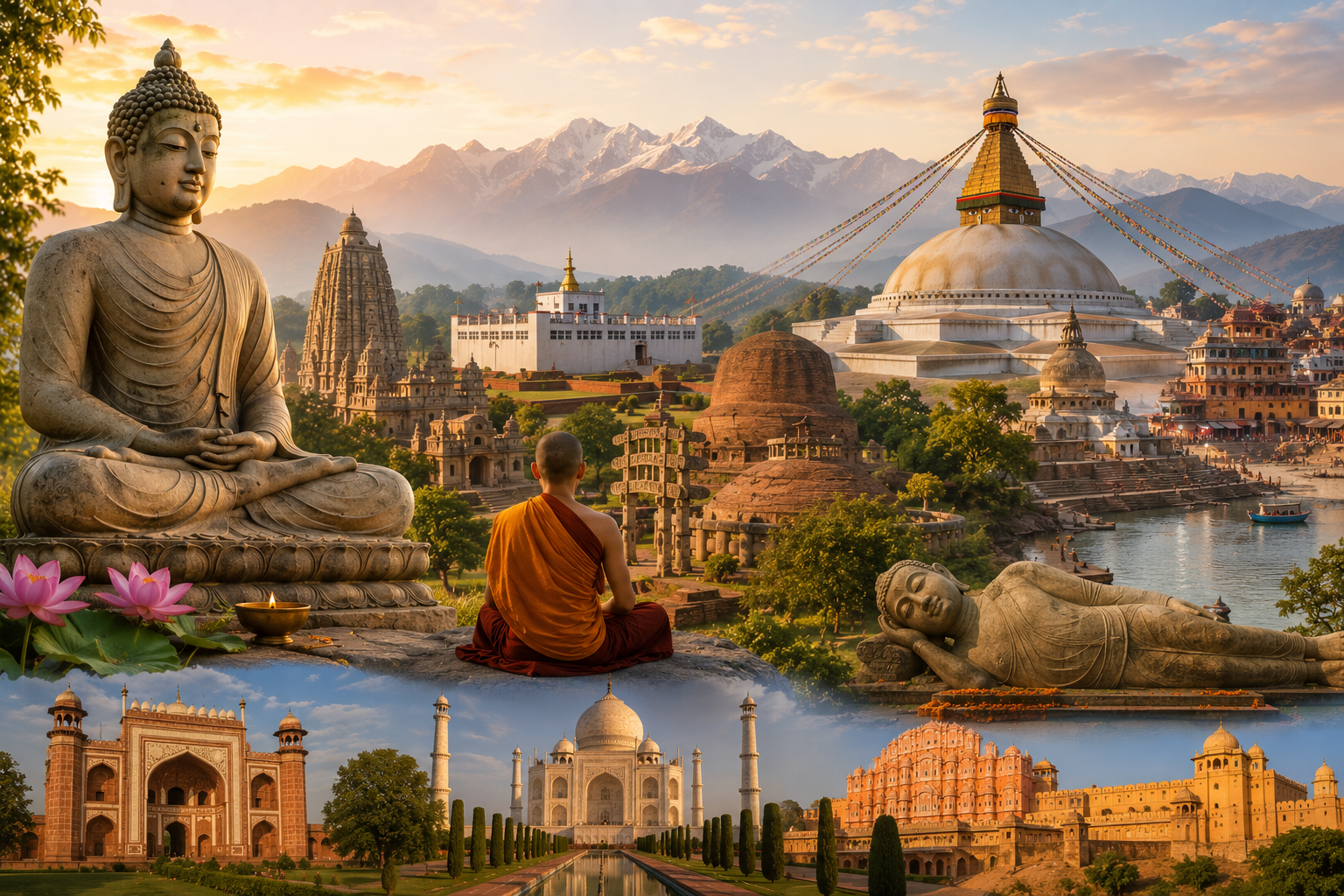
A 19-day spiritual pilgrimage for anyone interested in Buddhism. You will visit the most important pilgrimage sites in India and Nepal, often linked to events in the life of Siddhartha Gautama, the historical Buddha. You will discover Lumbini in Nepal, his birthplace; the famous Bodhi Tree in Bodh Gaya, under which he attained enlightenment; Sarnath near Varanasi, on the banks of the sacred Ganges, where he first preached; and Kushinagar, where he passed away. Sanchi and Sravasti are also part of this itinerary. Finally, you will visit India’s Golden Triangle: Delhi, Jaipur, and Agra. Expert guides will introduce you to the fascinating world of Buddhism and its many customs and legends.
Why this trip?
- A unique, off-the-beaten-path journey to the roots of Buddhism, where you will discover the richness of Buddhism and its culture.
- Accompanying an English-speaking local guide at tourist destinations.
- An English-speaking guide will accompany you from Bodhgaya to Lucknow, taking time to explore key sites.
- Transportation with a private driver (choose from a standard car or SUV, plus an additional charge). For four or more people, a comfortable minibus is available.
- Entry fees to tourist destinations and the services of an English-speaking local guide are included in the tour price.
Your journey with "Best Travel Agents in India" begins today. Upon arrival at New Delhi Delhi International airport, you will be greeted by our English-speaking representative and transferred to your hotel
Accompanied by an English-speaking guide, you will visit New Delhi and Old Delhi. The main difference between the two parts of the city lies in their history: New Delhi was founded by the British, while Old Delhi has much older origins. As a result, New Delhi is systematically organized and has a more formal and modern appearance, unlike Old Delhi, which has a more chaotic atmosphere. During the tour, you will see the Qutab Minar, the Red Fort, India Gate, Raj Ghat (Mahatma Gandhi Memorial), the tomb of the Mughal Emperor Humayun, and the lively Chandni Chowk district.
The morning and afternoon are free. In the late afternoon, you will be transferred to the train station to board the overnight train to Varanasi. You will spend the night on board. While Indian overnight trains are not the most comfortable in the world, traveling by train is a great way to meet the local people. Most of the Indians on the train speak fairly understandable English. By chatting, you'll learn a lot about life in India. Departure from Delhi around 7:30 pm - arrival in Varanasi around 7:30 am.
Tip: Bring extra food to share in your compartment. Your fellow travellers often do the same!
Upon arrival in Varanasi, you will be transferred to your hotel where you can freshen up. The rest of the morning is free. In the afternoon, you will depart with your private driver and guide for Sarnath, the site of the ancient deer park where the Buddha delivered his first teachings (approximately 10 km). (For immediate check in, we can hold the room from previous day)
In the morning, you will be taken to the banks of the Ganges for a boat trip. You will discover the unique symbolism of the river and observe pilgrims bathing and meditating in its waters: a deeply moving experience. Next, you will take a city tour. In the afternoon, you will continue your journey to Bodh Gaya (approximately a five-hour drive).
Bodh Gaya, also spelled Buddh Gaya or Bodh Gaya, is considered the most important of the four major Buddhist pilgrimage sites. It is also known as the "navel of the world." Legend has it that when the world disappears, Bodh Gaya will be the last place to vanish. You will visit the Mahabodhi Temple, where you will see the sacred Bodhi tree, the Pagoda Fig (Ficus religiosa), recognizable by its heart-shaped leaves. It was here that the Buddha attained enlightenment through his own efforts, on the very spot where the "Diamond Throne" now stands. He was not the first to achieve enlightenment, but he is the most famous. The current Bodhi tree is a sixth-generation descendant of the original tree, and more distant descendants of this tree can also be found in many other places around the world. As impressive as the tree itself are the crowds of devout pilgrims from all over the world. These are not only Buddhists; the Buddha is also a sacred figure in Hinduism. The rest of the day is free.
After breakfast, transfer to Patna (approximately a five-hour drive). En route, stops will be made at Rajgir and Nalanda. Rajgir is the capital of the ancient kingdom of Magadha, where the Buddha and Mahavira lived. Mahavira, the founder of Jainism, lived around the same time as the Buddha. Rajgir is an important place for Jains, as it is home to many temples and monuments. Vulture Peak is of particular interest to Buddhist pilgrims. The Buddha would retreat here to meditate and teach small groups. It is a serene place offering a magnificent, verdant panorama. Discuss with your guide how much time you would like to dedicate to this visit; this can be arranged. At Nalanda, you will visit the ruins, where you will discover numerous remnants of a glorious past. You will also visit a famous Buddhist monastic university, where lectures were first given, replacing individual instruction.
You continue your journey to Kushinagar, a trip of approximately six hours. En route, you will visit Vaishali, one of the Buddha's favorite places, where he traveled many times during his journeys in India. Kushinagar was the world's first republic with elected representatives. This place holds special significance for Buddhists, as the Buddha died there at the age of 80 and, as an enlightened being, was thus liberated from the cycle of birth, death, and rebirth, also known as parinirvana. One of the eight stupas, the most important, was built there to house his ashes. In the following centuries, a flourishing trade in his relics developed. Among these are a surprisingly large number of teeth, venerated in various parts of Asia.
After breakfast, visit Kushinagar. You will discover the Rambhar stupa and the Mahaparinirvana temple, which houses a Buddha statue. Then, continue to Lumbini, located at the foot of the Himalayas in south-central Nepal (approx. four hours' drive). This is the birthplace of Gautama Buddha, the founder of Buddhism. Part of the site is a nature reserve where you can observe the nilgai. Its name literally means "blue cow," but it looks more like a deer. You may also spot sarus cranes; with a wingspan of 2.5 meters, they are the largest flying birds in the world.
Today, visit Lumbini. You will stroll through the sacred garden and visit the Mayadevi Temple and Puskarni, the sacred pool where Mayadevi, the mother of Buddha, bathed before his birth. The birth was miraculous: a shower of flowers fell, and the infant Siddhartha Gautama immediately took his seven steps. His mother, Mayadevi, died a week after his birth. The site contains several pagodas from different countries. Interestingly, each has a distinct architectural style. Between the birthplace and the World Peace Pagoda is the Flame of Peace. It was lit in 1986, the year the UN proclaimed the International Year of Peace.
Today, you will continue your journey to Sravasti. On the way, you will visit Kapilavastu, the capital of the Savka clan. This place is very important for Buddhist pilgrims and is home to several stupas. You will then be transferred to your accommodation in Sravasti. The Buddha spent most of his last twenty years in Sravasti, and the remains of his hut still exist. There are also several temples and stupas there.
In the afternoon, transfer to Lucknow train station. Lucknow is famous for its silks, perfumes, and jewelry. Continue your journey by train to Bhopal. Overnight on board. Departure from Lucknow around 7:45 pm - arrival in Bhopal around 6:00 am.
Arrival in Bhopal early in the morning. Transfer to your hotel. City tour of Bhopal. Bhopal boasts beautiful lakes located in the heart of the city. Two rivers meet here, and the city is renowned for its beautiful parks. You can enjoy the surroundings and relax
A day trip to Sanchi, in the state of Madhya Pradesh, in central India. Sanchi is home to the Great Stupa, the most magnificent stupa from ancient India still in existence. A stone enclosure, pierced by toranas (gates), surrounds this imposing temple. Worshippers circumambulate the dome, which represents the mountain of the world. You will also discover monasteries, temples, and various columns.
After a free morning, depart around noon for Bhopal Railway Station. From there, you will take the train to Agra. Upon arrival in Agra, you will be transferred to your hotel.
Note: Instead of visiting the "Golden Triangle" (Delhi, Agra, and Jaipur), we can also choose another way to end the trip. For example, a short excursion to a region where Buddhism is still very much alive, such as the Himalayan state of Sikkim or the Buddhist state of Bhutan. Inquire about the possibilities.
Early in the morning, you will visit a monument with a completely different history from the buildings already seen on this trip: the famous Taj Mahal (closed on Fridays). Commissioned by the Mughal emperor Shah Jahan for his deceased wife, Mumtaz Mahal, the Taj Mahal is the most famous UNESCO World Heritage Site. After an in-depth visit, we will head to Agra Fort. This fort, surrounded by 2.5 kilometers of walls, was built in the 16th century to protect the city. Because of the color of its red sandstone, it is also called the Red Fort. You will also visit the Itmad-ud-Daulah Mausoleum. This mausoleum was commissioned by Noor Jahan, wife of the Mughal emperor Jahangir and mother of Shah Jahan. It is also nicknamed the "Little Taj" because of its resemblance to the Taj Mahal.
Tip: Only essential items are allowed inside the Taj Mahal. Please leave your bags in the car. Your guide will inform you of this in advance. Please also note that visits to the Taj Mahal are limited to three hours. This new rule aims to prevent large gatherings at the site.
Today, you will travel to Jaipur by car (approximately a 5-hour drive). En route, you will visit Fatehpur Sikri, the "abandoned city" of Emperor Akbar. Due to a lack of water, this former capital of the Mughal Empire is deserted. You will also have free time to explore Jaipur, the capital of Rajasthan. Nicknamed the "Pink City" because of the pink sandstone used in its buildings, it offers a sense of freedom. Upon arrival, you can visit the Art Museum, the Govinda Deva Temple, or stroll through the Johari Bazaar. Here and there, you might spot a camel strolling along the road, sometimes pulled by a cart.
In the morning, visit Amber Fort. A jeep will take you to the fort's entrance. You'll have plenty of time to explore and wander through the many rooms of this palace-fortress. The ramparts, which wind their way up the hills as far as the eye can see, are also impressive. In the afternoon, visit Jaipur. You'll discover, among other things, the City Palace, the Hawa Mahal (Palace of Winds), and the Observatory.
After breakfast transfer to Delhi Airport (approximately six hours) for your return flight.
Note: Depending on your flight schedule, we can book a hotel room or accommodation in Delhi for the night (not included).
Included
- Traditional welcome on arrival at New Delhi
- Assistance during your trip (available 24/7)
- Transfer and transportation in an air-conditioned car with a private driver during your excursion
- Train travel (1st Class ac sleeper)
- Accommodation as per the travel plan
- Meals as per travel plan
- Services as per travel plan
- Expert, English-speaking local guides at tourist destinations
- English-speaking tour guide from Bodhgaya to Lucknow
- Sightseeing locations with entrance fees
- Two-time boat ride at Varanasi (Ganga River)
- Jeep ride at Amber Fort in Jaipur
- Complete information pack containing country information, vouchers, e-tickets, and hotel lists, as well as your travel documents
- Enough water in the car during driver hours
Excluded
- International flights fare
- Visa expenses
- Visa for Nepal (Also available: Nepali Visa on Arrival)
- Excursion & Entry Fees
- Early Arrival/Late Departure Options (depend on availability)
- Tips to driver, guide, hotel staff, any monks, boat man etc.