
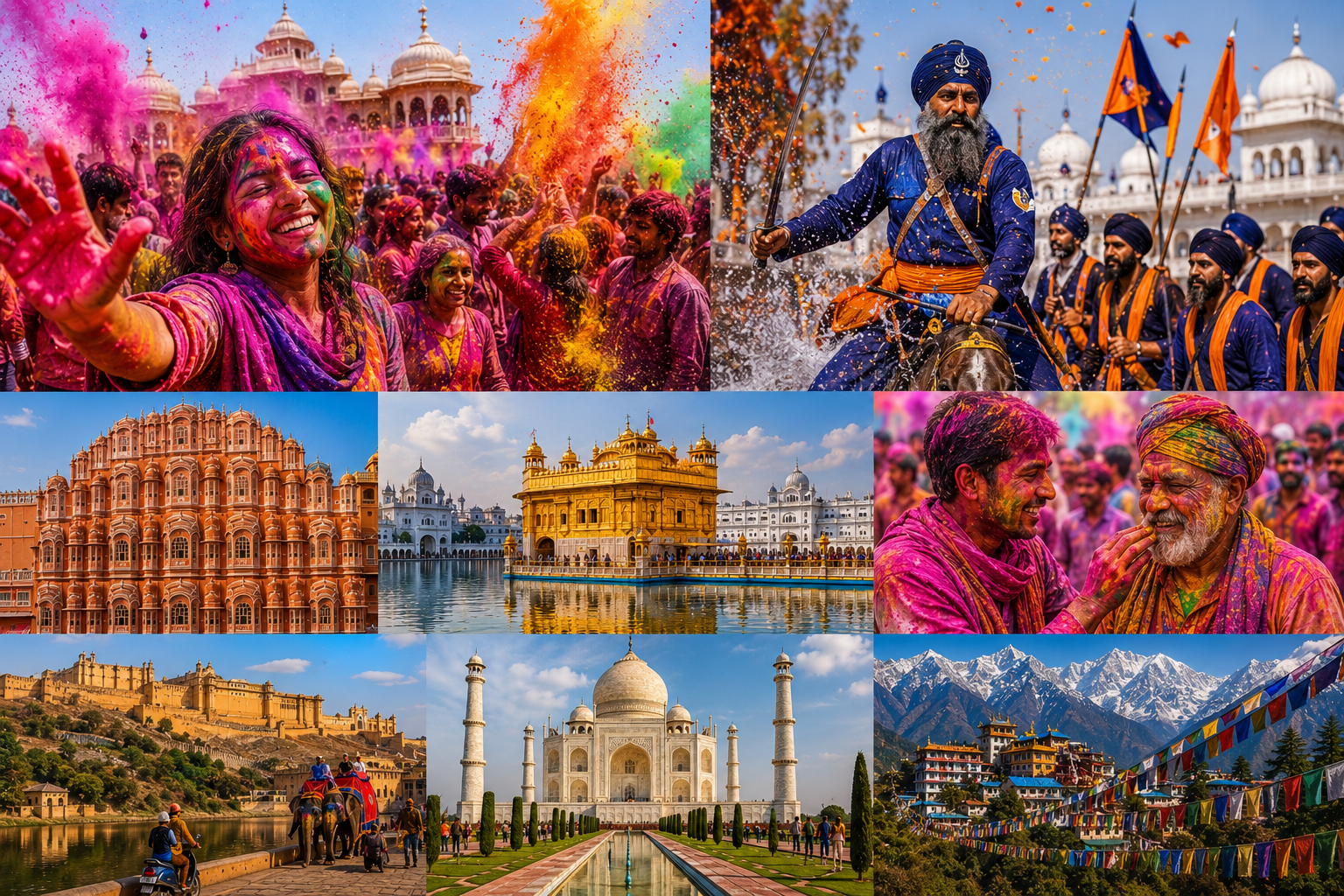
A burst of color: Holi festival in India! Young and old alike take to the streets and throw colors on each other until they resemble rainbows. On this self-guided tour, you’ll witness this Hindu festival of the triumph of good over evil in Mathura, where it’s celebrated with particular enthusiasm. You’ll also see a completely different side of the festival at Hola Mohalla in Anandpur Sahib, the Sikh version of Holi. You’ll travel with a private guide who will explain the cultural context of this ritual, but you can also skip the theory and join the party! Happiness guaranteed…
This trip is a goldmine for photographers. Of course, there’s Holi and its vibrant colors, but you’ll also see some particularly photogenic buildings. For example, the Golden Temple in Amritsar, the vibrant heart of Sikh culture, as well as the Amber Fort, a magnificent stepwell, and the Palace of Winds (Hawa Mahal) in the Pink City of Jaipur, and the Taj Mahal, a magnificent monument in Agra, don’t forget. Besides Hinduism and Sikhism, Buddhism can also be found in the mountainous Dharamsala, which has a Tibetan vibe. Simply put, this is a truly unique and rewarding cultural journey.
Why this trip?
- Rich in photogenic landscapes and buildings, it's ideal for photography enthusiasts.
- Private accompaniment by an expert during the festivals.
- A unique trip including the Holi and Hola Mohalla celebrations.
- A blend of Hinduism, Sikhism, and Buddhism all in one journey.
- Transportation in a comfortable SUV with a private driver.
Your journey with "Best Travel Agents in India" begins today. Upon arrival at New Delhi International Airport, our representative will greet you and escort you to your hotel in the city. Arrivals are often at night, sometimes after midnight; in this case, we calculate one more night.
After some relaxation before your return flight, you'll set off with your guide. Your first stop will be Chandni Chowk, a bustling shopping district with narrow lanes and thousands of small shops. You'll be amazed! You'll also discover the Jama Masjid, the largest mosque in the city. Flocks of pigeons soar above its magnificent domes and minarets. Nearby stands the Red Fort, built in 1639 on the orders of the Mughal emperor Shah Jahan. Later, you'll explore a completely different side of Delhi in Lutyens', a district of New Delhi. This area is characterized by its wide avenues and vast plots, designed by Sir Edwin Lutyens and Sir Herbert Baker in 1911. After visiting India Gate, you'll conclude this diverse exploration of Delhi at Connaught Place, a large roundabout with multiple bypasses, where British influence is ever-present. Here, traditional Indian restaurants stand alongside world-renowned fast-food chains.
After breakfast, head to Mathura, Uttar Pradesh, one of the holiest places in Hinduism (about a 3-hour drive). This city is famous because the beloved Lord Krishna was born there. It's no surprise that it's home to numerous temples and attracts a large number of pilgrims. The Yamuna River flows near the city, and along its banks are numerous ghats (bathing places) where pilgrims bathe. This is a great opportunity to relax and observe local life. Because the festival of Holi originated in Mathura with the birth of Lord Krishna, it is celebrated with particular enthusiasm. Your guide will tell you several stories related to the origins of Holi, many of which feature Lord Krishna in a playful manner.
Celebrated on the day after the full moon in March, this festival marks the end of winter and the beginning of spring and the harvest season. It symbolizes the victory of good over evil, personified by the demon Holika. Even today, Holi is celebrated by lighting a large fire (Holika Dahan) the day before. In 2027, Holi fell from March 21 to March 22. In most places, the festival peaks on March 20th and 21st, but in the Mathura region, it occurs a week earlier. This week, various temples in Mathura and Vrindavan display a spectacular display of bright colors.
The Holi festival begins early in the morning. Adults and children throw gulal (colored powder) at each other. People sprinkle colored water on passersby from balconies, children fill water balloons, and sometimes, entire buckets of colored water are poured on participants. Cheerful colors, enthusiastic crowds, and a joyous atmosphere: a truly unique festival. Visiting a temple is a good idea, but if it gets too crowded and the atmosphere becomes chaotic, your guide can take you to a quieter location. Of course, it's best to wear white, as it makes the colors pop even more. Your guide will provide you with a disposable white kurta-pyjama, a simple traditional outfit consisting of a long blouse and fitted trousers. Holi celebrations (or "Holi Khela," as it's called in the local language) sometimes involve the consumption of bhang, a marijuana-based drink, especially by men. Therefore, it's advisable to start early and stay with your guide before the bhang's effects become too strong. You'll experience the festival in Nandgaon or Barsana, near Mathura. The exact schedule of events will be announced shortly.
Tip: Keep your valuables in a waterproof bag and bring disposable sunglasses to protect your eyes from eye irritation from the dye.
Today, 1h30 drive will take you to Agra, beautifully situated on the banks of the Yamuna River. Between 1526 and 1628, Agra was the capital of the Mughal Empire, as evidenced by numerous monuments from that period, including the famous Taj Mahal, India's symbol, as well as the Agra Fort and the haunted city of Fatehpur Sikri. All three are UNESCO World Heritage Sites. After checking in at your hotel, you'll first visit the Agra Fort. Built between 1565 and 1571 under the supervision of Mughal Emperor Akbar (grandfather of Shah Jahan, patron of the Taj Mahal) to protect the city, it is also known as the Red Fort due to its red sandstone facade. It is essentially a fortified castle-like city surrounded by a wall at least 2.5 kilometers long. Although its primary purpose was military, Shah Jahan converted it into a palace. Interestingly, this site later became his own prison when his son, Aurangzeb, seized power and imprisoned him.
As the sun sets, head to Mehtab Bagh (Moonlight Garden) for a romantic view of the Taj Mahal. These gardens are located on the other side of the Yamuna River. It's an ideal spot to watch the sunset over the Taj Mahal, away from the crowds. After sunset, wander through the labyrinth of narrow lanes of Old Agra. You'll find many colorful markets, each specializing in a specific product. You'll find stalls selling shoes, jewelry, marble, snacks, and millions of customers—or at least, that's what it feels like sometimes! And amidst all this hustle and bustle, it's not uncommon to spot a buffalo or an elephant.
As soon as the gates open—since it's quietest during that time—you'll tour the magnificent Taj Mahal with your guide. An added bonus is the beautiful sunlight falling on the structure at sunrise. The Taj Mahal was built by Mughal Emperor Shah Jahan for his late wife, Mumtaz Mahal. It took nearly 20 years to complete. You'll be amazed by the beautiful details and perfect symmetry of this monument. Shah Jahan envisioned a similar monument for himself, but in black. However, it was never built. He was buried next to his wife in a mausoleum inside the Taj Mahal. His tomb is the only thing in the entire building that breaks the symmetry. When the crowds arrive, you'll return to your hotel for a late breakfast.
You'll then visit other sites in Agra, such as the Royal Tomb, also known as the Baby Taj. This building, officially called Itimad-ud-Daulah, is believed to predate the Taj. This mausoleum was built by Nur Jahan, wife of Mughal Emperor Jahangir and mother of Shah Jahan.
You will then be transported to Jaipur in 4-5 hours, but on the way, you will also visit Fatehpur Sikri, the "abandoned city." Due to a lack of water, this former capital of the Mughal Empire is deserted.
In the evening, you will wander through the bazaars of Old Jaipur. Another excellent opportunity for photography enthusiasts. Ficus trees grow from old, crumbling walls, you will find centuries-old temples in niches that are still used with devotion, and many colorful embroidered fabrics are for sale.
Tip: Only essential items are allowed inside the Taj Mahal. Leave any bags in the car. Your guide will inform you of this in advance. It's also good to know in advance that the Taj Mahal tour will only take three hours. This new rule is to avoid overcrowding in the grounds.
In the morning, you'll visit Amer Fort. A jeep will be waiting for you at the base of the fort to take you upstairs. You'll have plenty of time to explore the palace's many halls. A little off the beaten track, you'll reach Panna Meena Ka Kund, a very photogenic spot. This 16th-century well was built to store water, but it also served as a meeting place. Several steps lead down to the cool water. A beautiful sight.
Later today, you'll tour the city of Jaipur. You'll see, among other things, the Observatory and, of course, the famous Hawa Mahal (Palace of the Winds). This five-story pink sandstone facade was built in 1799 so that wealthy women could observe the street life below, unobserved, from behind its 593 small windows.
You'll end the day with a special experience: you'll be the guest of a local, special Rajasthani family. You'll cook dinner with them. After this Rajasthani cooking lesson, it's time to share the prepared dishes. Learning to cook local food is fun, but it's equally special to see how things work in such a family. You'll learn a lot about the local culture through your interactions.
After breakfast, transfer to the airport for a domestic flight to Delhi. From there, you'll take another flight to Chandigarh. A two-hour drive (85 kilometers) will take you to Anandpur Sahib, where you'll spend the next three nights. Expect to arrive in the evening.
The next few days will be dedicated to the Hola Mohalla festival (also known as Hola Mola). Although it's often confused with Holi, its origins are quite different. Hola Mohalla is actually a festival of Punjabi culture, and specifically, the Nihang warriors of the Khalsa sect. In 1699, the tenth Sikh Guru (religious leader), Gobind Singh, founded the Khalsa: a group of courageous and selfless people who dedicated their lives to helping the poor and oppressed and fighting injustice. During Hola Mohalla, the Nihang warriors of the Khalsa showcase their skills through mock battles and poetry competitions. This display of their values and abilities is a source of inspiration for ordinary Sikhs. They come to the festival in brightly decorated trucks because they love to celebrate and eat good food!
Today, you'll witness another day of the three-day Hola Mohalla festival. You'll witness demonstrations of horse riding, sword fighting, mock battles, and archery: a glimpse of the battles Sikhs fought against their enemies in medieval India. The entire event features spectacular performances, gleaming swords, magnificent turbans, and a display of the courage and pride of the Nihang/Khalsa warriors. They look impressive with their Pangeya (blue and orange) attire, their thick, curly moustaches, large turbans, swords, steel bracelets, and long beards. After displaying their skills, it's time to throw colors on each other, just like during Holi.
An important part of this festival, and a true crowd-pleaser, is the langar. A langar is a community kitchen, often attached to a Sikh temple. Volunteers prepare food there day and night, which is distributed free to everyone, regardless of their background or religion. The amount of food prepared during the three days of Hola Mohalla is enormous: 18,000 kg of grains, 29,000 kg of pulses, 13,000 kg of rice, 25,000 kg of sugar, 19,000 kg of ghee, and over 3,000 kg of vegetables. Imagine! In just three days, enough food is used here to feed a family for seven years. The kitchens are very busy right now, so it's best to avoid going there. But later (after Dharmshala / McLeod Ganj), you're welcome to visit the Golden Temple in Amritsar!
After a few days of festivities, it's time to relax. A six-hour drive will take you to Dharamshala (McLeod Ganj), where you'll spend the next three nights. Dharamshala is located in the mountainous state of Himachal Pradesh. The slightly higher part of town is called McLeod Ganj. It was a small town until 1959, when it underwent a major transformation: the 14th Dalai Lama settled here after fleeing Tibet. He built a temple and a monastery. You'll find a comfortable and welcoming stay in a quiet area, close to main roads. The town attracts both contemporary hippies and nostalgics, making it an ideal place to enjoy its many charming cafes, cozy atmosphere, and delicious freshly baked pastries. With the backdrop of the Dhauladhar Range, this mountain resort is also perfect for strolling among the Himalayan pine trees.
Today, you'll have time to breathe in the city's fresh mountain air. You'll discover the large Tibetan community, which has a significant influence on local culture. After exploring Hinduism and Sikhism, it's time for Buddhism. A guide and driver will be available to assist you. On your arrival, you can discuss your favourite sights with your guide. The Dalai Lama Temple Complex is a must-see, as well as the Tibetan Institute for the Performing Arts, the Nam Art Gallery, and the Neo-Gothic stone church known as St. John in the Desert. The Norbulingka Institute is also worth a visit, where you can see workshops on woodcarving and thangka, the large embroidery appliqués of the Tibetan Buddhist tradition. The Tibet Museum, Dolma Ling Monastery (home to 240 nuns), Namgyal Monastery, and the Kalachakra Temple deserve special mention. End the day by exploring the McLeod Ganj market, where, in addition to fresh produce, you'll find a variety of handmade goods. This is the perfect opportunity to purchase some lovely handmade souvenirs.
After breakfast, head to your next destination: Amritsar, a city in the heart of Punjab and the spiritual center of Sikhism. Amritsar is particularly known for its Golden Temple and its sizable Sikh community. After freshening up at the hotel, you'll visit the famous Golden Temple, Harmandir Sahib. The Golden Temple is reflected in the surrounding waters. The combination of the temple's gold and the white marble of the pathways is a spectacular sight, both literally and figuratively! Pilgrims bathe in the surrounding waters and are provided with food from the temple. Approximately 100,000 people are fed every day; imagine how much food this represents! It's truly impressive. You can peek into the large kitchen and, if you feel like it, offer a helping hand: any assistance is welcome. Help chop vegetables or wash dishes in the large basin—it's a great opportunity for conversation. Surrounding the magnificent Golden Temple, you'll find bustling markets and a maze of narrow streets.
You'll start the day with a hearty meal and a tour of Jallianwala Bagh, the site of the 1919 massacre of Sikhs by the British. This event sparked India's fight for independence. You'll also visit the Ram Bagh Museum. This former summer palace of Maharaja Ranjit Singh is particularly worth seeing for its magnificent gardens, inspired by Lahore's famous Shalimar Gardens. There, you'll see unique plants, fountains, and canals. In the afternoon, you'll head to the Wagah border crossing between India and Pakistan, about 30 km from Amritsar. At sunset, you will witness the flag lowering ceremony. This is a special ritual held at the India-Pakistan border, which remains closed daily. You can view this spectacle from a specially constructed platform. In the evening, if you wish, you can visit the Golden Temple. Beautifully illuminated, it creates a truly unique atmosphere.
Today, you will take a domestic flight from Amritsar to Delhi. Upon arrival at the airport, you will be taken to a nearby hotel. You can freshen up and rest before your international flight departs, usually after midnight. You will be taken back to the airport well in advance. End our services.
Included
- Assistance during your trip (available 24/7)
- Traditional welcome on arrival at New Delhi & Amritsar airports by our local representative.
- All accommodations as specified in the program
- All services as specified in the program
- Transfers and transportation during your trip in an SUV (e.g., Toyota Innova) with a private driver
- Specified sightseeing points and their entry fees
- Meals as specified in the program
- Expert English-speaking guide during festivals and excursions
- Kurta Pajama (traditional clothing) for Holi celebrations
- Cooking class and dinner in Jaipur
- Complete information pack containing country information, vouchers, e-tickets, and a list of hotels along with your travel documents
Excluded
- Any personal expenses (as laundry)
- International Flights
- Indian Visa Fee:
- Transportation during the day and at different times of the day
- Free time (excluding sightseeing)
- Optional excursions and related entry fees
- Tipping - driver, hotel or restaurant staff, local guide, etc.
- Early arrival/late departure option
- Travel and cancellation insurance